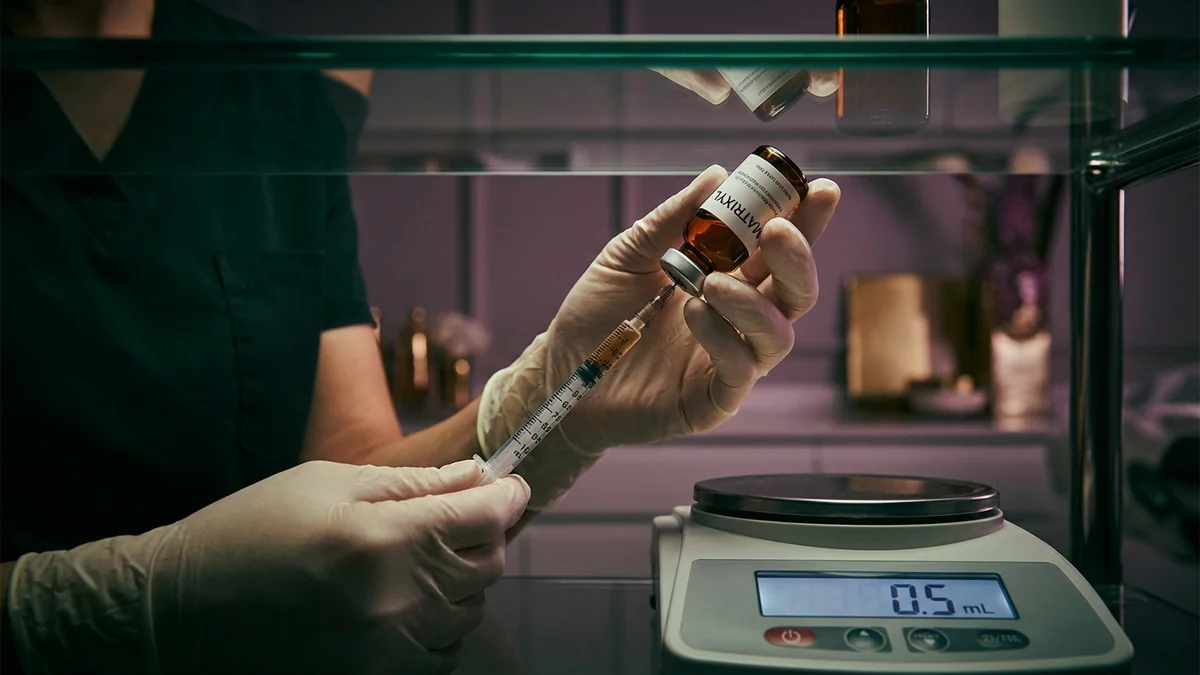
What Is Matrixyl?
Matrixyl is a cosmetic peptide. Its ingredient name is palmitoyl pentapeptide-4, and its structure is pal-KTTKS: the five amino acids lysine, threonine, threonine, lysine and serine, with a 16-carbon palmitic acid chain attached to one end. Some papers call it palmitoyl pentapeptide-3.[1]
The KTTKS sequence comes from type I procollagen, the precursor of the main structural protein in skin. In 1993, researchers found that this five-amino-acid fragment was the smallest piece of a larger procollagen fragment that still strongly stimulated collagen and fibronectin production in cultured cells.[2] Cosmetic chemists later attached the fatty acid so the peptide would cross the skin's outer layer more easily.
Matrixyl is sold in two very different ways. In skincare, it is a low-concentration ingredient in anti-wrinkle creams, with a small set of human studies behind it. As a "research peptide," it is sold as powder in vials (200 mg, for example), and searches for injecting it are common. The evidence covers the first use only.
- Matrixyl is palmitoyl pentapeptide-4 (pal-KTTKS), a fatty-acid-linked fragment of procollagen used in anti-wrinkle skincare.
- The main human trial (93 women, 12 weeks, split-face) found fewer wrinkles and fine lines with a moisturizer containing just 3 ppm of pal-KTTKS than with the same moisturizer alone.
- The human evidence is small: a handful of trials, several run by a cosmetics company, and most testing multi-ingredient products.
- No study has injected Matrixyl into people. There is no injected dose, and injecting it would make it an unapproved drug in FDA terms.
- We found no CIR safety assessment of palmitoyl pentapeptide-4 in PubMed. Topically, the published trials report it as well tolerated.
| Trade Name | Matrixyl |
| Ingredient (INCI) Name | Palmitoyl pentapeptide-4 (also called palmitoyl pentapeptide-3) |
| Structure | Palmitoyl-Lys-Thr-Thr-Lys-Ser (pal-KTTKS) |
| Formula / Molecular Weight | C39H75N7O10 / about 802 Da |
| Class | Lipidated "signal" peptide, cosmetic ingredient |
| Origin of Sequence | Fragment of the type I procollagen C-terminal propeptide |
| Route Studied in Humans | Topical only |
| Concentration in Main Trial | 3 ppm (0.0003%) in a moisturizer |
| Injectable Human Data | None |
| FDA Status | Cosmetic ingredient; no premarket approval required for cosmetics; not approved as a drug |
| Not the Same As | Matrixyl 3000 (palmitoyl tripeptide-1 plus palmitoyl tetrapeptide-7) |
How Does Matrixyl Work?
The idea is that skin cells read collagen fragments as a signal that collagen is being broken down and needs replacing. KTTKS mimics one of those fragments.
In cells. The original 1993 work showed KTTKS stimulated type I collagen, type III collagen and fibronectin in a range of connective tissue cells, in a dose- and time-dependent way.[2] Later work with the palmitoylated form found it raised collagen production in human skin and corneal fibroblasts, in step with concentration, at around the point where the molecules start clumping together into tiny tape-like structures.[3] A 2011 review concluded there was "a sound in vitro basis" for its action on fibroblasts, specific to collagen I, collagen III and fibronectin.[4]
Getting through skin. This is the weak link for most cosmetic peptides. The same review pointed out a "surprising absence" of skin penetration data.[4] A 2014 study in hairless mouse skin found that the unmodified KTTKS did not enter skin at all, while pal-KTTKS reached every layer, though only 0.3 µg/cm² made it to the dermis, where collagen is made. Both forms were broken down quickly by skin enzymes, with the palmitoylated form lasting longer.[5] A 2022 review concluded that most anti-wrinkle peptides, KTTKS included, probably don't reach their targets at the right concentrations without help from delivery methods.[6]
Matrixyl vs. Matrixyl 3000
These are different ingredients. Matrixyl is pal-KTTKS. Matrixyl 3000 combines two other peptides, palmitoyl tripeptide-1 (pal-GHK) and palmitoyl tetrapeptide-7 (pal-GQPR).[7] In a 2026 study in three volunteers, both Matrixyl 3000 peptides were detected through every layer of the skin's outermost layer after a serum was applied, but only on the outside of the cells, not within them.[7] Findings for one product do not transfer to the other.
What the Clinical Evidence Actually Shows
The human evidence for Matrixyl is a short list. Here is all of it that we could verify in PubMed.
The main trial (2005). 93 white women aged 35 to 55 applied a moisturizer to one side of the face and the same moisturizer with 3 ppm pal-KTTKS to the other, for 12 weeks, in a double-blind, randomized design. The pal-KTTKS side showed significant improvement in wrinkles and fine lines on both image analysis and expert grading, and participants noticed it themselves. It was well tolerated.[8] The study came from Procter & Gamble.
Multi-ingredient products. Two small split-face studies (42 and 35 women) tested P&G products containing niacinamide, pal-KTTKS, another peptide (pal-KT) and carnosine, and found smoother skin and shallower wrinkles around the eyes after 4 weeks compared with no treatment.[9] Because the products had several actives, the result cannot be credited to Matrixyl alone.
Against tretinoin (2010). In 196 women, a cosmetic regimen containing niacinamide, peptides and retinyl propionate improved wrinkle appearance more than 0.02% tretinoin at 8 weeks and about the same at 24 weeks, and was better tolerated.[10] The abstract does not name the peptides, the product combined several actives, and the study came from P&G.
An independent small trial (2023). In 21 Indonesian women over 8 weeks, a palmitoyl pentapeptide-4 cream was compared with an acetyl hexapeptide-3 (Argireline) cream and placebo for crow's feet. The authors reported that the pentapeptide-4 cream gave better results than both, but with about seven women per group, they called it an initial study.[11]
That is the core of it: one reasonably sized single-ingredient trial from the company that makes products with it, a few multi-ingredient product studies, and one very small independent trial.
What the Evidence Does Not Show
- Collagen increase in human skin. The trials measured how wrinkles look. None in our search took biopsies to show more collagen in people.
- Long-term results. The longest single-ingredient study ran 12 weeks.[8]
- The best concentration. The main trial used 3 ppm.[8] No published human study compared doses.
- Anything about injection. No human study has injected pal-KTTKS. The closest work is lab-based: one study found microneedles raised pal-KTTKS delivery into excised human skin by 2 to 22 times,[12] and a 2025 cell-culture study combined Matrixyl with injectable platelet-rich fibrin on fibroblasts in a dish.[13] Neither is evidence for injecting it.
- Independent replication at scale. Most of the human data comes from one company.
Typical Dosing — What the Research Has Used
No injectable dose exists
Matrixyl has only been studied in people as a topical cream ingredient. There is no studied dose for injection, and no daily injected amount has any evidence behind it.
Topical use. The main trial used a moisturizer containing 3 ppm pal-KTTKS on half the face for 12 weeks.[8] The eye-area product studies used 0.5 g applied twice daily for 4 weeks, but those products contained several actives.[9] The 2023 crow's feet trial applied cream twice daily for 8 weeks; the abstract does not give the concentration.[11]
Injection. Searches for "Matrixyl injection dosage per day" are common, and research vendors sell it as powder vials. No published study supports any injected amount. Pal-KTTKS is also a fatty-acid-linked peptide that self-assembles into aggregates in solution,[3] an added complication for any injectable form. We found no published formulation work showing it can be safely injected.
With tretinoin. No study has tested Matrixyl and tretinoin used together. The only comparison is the 2010 regimen-versus-tretinoin trial described above.[10]
Side Effects
Topical. In the main trial, pal-KTTKS was well tolerated.[8] In the tretinoin comparison, the peptide-containing cosmetic regimen was better tolerated than tretinoin by every measure through 8 weeks, including redness and dryness grading.[10] We found no published case reports of allergic contact dermatitis to pal-KTTKS in a PubMed search. Any skincare ingredient can still cause irritation or allergy in some people, and a finished product contains many ingredients besides the peptide.
A 2026 framework for screening cosmetic peptides, written by industry scientists, ran palmitoyl pentapeptide-4 through six bioinformatic tools for toxin and allergen signals. It showed sequence similarity to skin structural proteins (collagen, elastin, fibronectin) and did not raise the concerns that the tools flagged for known toxins.[14] That is a computer screen, not a clinical safety study.
Injected. There is no human safety data. The unknowns include local inflammation, infection from non-sterile powders, and immune reactions. Nobody has studied it.
Safety Assessments: CIR, EU and FDA
Regulatory status as of October 2026
Matrixyl is a cosmetic ingredient, not an FDA-approved drug. One clinic on our directory currently lists Matrixyl among the treatments it offers.
FDA. The FDA states that cosmetic products and ingredients do not need FDA premarket approval, with the exception of color additives. It also says that a product intended to treat or prevent disease, or to affect the structure or function of the body, is a drug, even if it affects appearance. A Matrixyl cream sold for "the appearance of wrinkles" sits in the cosmetic category. Matrixyl sold for injection to rebuild collagen would be an unapproved drug.
CIR (Cosmetic Ingredient Review). CIR's expert panel publishes its safety assessments in the International Journal of Toxicology, and it has assessed cosmetic peptides: in 2025 it concluded that another cosmetic peptide, acetyl hexapeptide-8 amide, is safe in cosmetics at concentrations up to 0.005%.[15] We did not find a CIR assessment of palmitoyl pentapeptide-4 among CIR reports indexed in PubMed. If one exists outside that index, we have not verified it.
EU (SCCS). We could not verify an opinion from the EU Scientific Committee on Consumer Safety on palmitoyl pentapeptide-4, so we do not state one.
Sourcing & Safety
For skincare, Matrixyl is easy to find in mass-market and premium creams. Two practical points:
- Ingredient lists use the INCI name. Look for "palmitoyl pentapeptide-4," not "Matrixyl." Products listing "palmitoyl tripeptide-1" and "palmitoyl tetrapeptide-7" contain the Matrixyl 3000 peptides instead.
- Concentration is rarely stated. The main trial used only 3 ppm,[8] and most products do not say how much they contain, so you usually cannot compare a product with the studied amount.
For research vials, the usual checks apply (third-party certificate of analysis, HPLC purity, mass spectrometry identity at about 802 Da), but none of those checks makes a cosmetic peptide powder suitable for injection.
What Makes Matrixyl Different
Matrixyl is a "signal" peptide, meaning it is meant to signal skin cells to make more matrix proteins. Argireline works differently, by dampening the muscle signaling behind expression lines. GHK-Cu carries copper and has broader wound-healing research.
Matrixyl vs. Other Cosmetic Peptides
| Parameter | Matrixyl | Argireline | GHK-Cu |
|---|---|---|---|
| Ingredient name | Palmitoyl pentapeptide-4 | Acetyl hexapeptide-3 | GHK bound to copper |
| Proposed role | Signals fibroblasts to make collagen and fibronectin | Reduces muscle signaling behind expression lines | Copper carrier involved in wound healing and collagen |
| Human evidence | One 93-person cream trial plus small product studies | Small cream trials | Limited cosmetic studies |
| Injectable human data | None | None | None published |
FAQ
What is Matrixyl?
Matrixyl is the trade name for palmitoyl pentapeptide-4, also written pal-KTTKS: the five amino acids lysine-threonine-threonine-lysine-serine with a palmitic acid (fatty acid) chain attached to help it enter skin. It is a cosmetic ingredient used in anti-wrinkle creams and serums, not a drug.
Is Matrixyl injectable?
It was designed and tested as a topical cream ingredient. No published human study has injected Matrixyl, and no injectable product has FDA approval. Vials sold as 'research' Matrixyl are not made for injection, and under FDA rules a product intended to change the structure or function of the body is a drug, not a cosmetic.
What is the Matrixyl injection dosage per day?
There isn't one. No trial has tested Matrixyl by injection, so no daily injected dose has any evidence behind it. The only human dose data comes from creams: the main trial used just 3 parts per million (0.0003%) of pal-KTTKS in a moisturizer applied to the face for 12 weeks.
What are the side effects of Matrixyl or Matrixyl 3000?
In the published cream trials it was well tolerated, and a 2010 study found a peptide-containing cosmetic regimen caused less irritation than prescription tretinoin. As with any skincare ingredient, irritation or allergy is possible. We found no published case reports of allergic reactions to pal-KTTKS. Injected use has no safety data at all.
Has Matrixyl had a CIR, EU or FDA safety assessment?
The FDA does not approve cosmetic ingredients before sale, apart from color additives. We did not find a Cosmetic Ingredient Review (CIR) safety assessment of palmitoyl pentapeptide-4 among CIR reports indexed in PubMed, although CIR has assessed other cosmetic peptides. We could not verify an EU scientific committee opinion, so we do not state one.
Can you use Matrixyl with tretinoin?
No study has tested Matrixyl and tretinoin together. One 2010 trial compared a cosmetic regimen containing niacinamide, peptides and retinyl propionate against 0.02% tretinoin: the cosmetic regimen improved wrinkles more at 8 weeks, matched tretinoin at 24 weeks, and was better tolerated. The cosmetic company that makes the regimen ran the study.
Related Peptides & Comparisons
If you are comparing skincare peptides, Argireline, GHK-Cu and our broader page on copper peptides are the closest matches, and AHK-Cu is a copper peptide marketed for hair. For the wider category, see our guide to anti-aging and longevity peptides.
References
- Tałałaj U, Uścinowicz P, Bruzgo I, et al. "The Effects of a Novel Series of KTTKS Analogues on Cytotoxicity and Proteolytic Activity." Molecules. 2019;24(20). PMID: 31618846
- Katayama K, Armendariz-Borunda J, Raghow R, et al. "A pentapeptide from type I procollagen promotes extracellular matrix production." J Biol Chem. 1993;268(14):9941-4. PMID: 8486721
- Jones RR, Castelletto V, Connon CJ, et al. "Collagen stimulating effect of peptide amphiphile C16-KTTKS on human fibroblasts." Mol Pharm. 2013;10(3):1063-9. PMID: 23320752
- Abu Samah NH, Heard CM. "Topically applied KTTKS: a review." Int J Cosmet Sci. 2011;33(6):483-90. PMID: 21535443
- Choi YL, Park EJ, Kim E, et al. "Dermal Stability and In Vitro Skin Permeation of Collagen Pentapeptides (KTTKS and palmitoyl-KTTKS)." Biomol Ther (Seoul). 2014;22(4):321-7. PMID: 25143811
- Mortazavi SM, Moghimi HR. "Skin permeability, a dismissed necessity for anti-wrinkle peptide performance." Int J Cosmet Sci. 2022;44(2):232-248. PMID: 35302659
- Trzaska AH, Kotowska AM, Starr NJ, et al. "Permeation behaviour of cosmetic actives into the human stratum corneum." Int J Pharm. 2026;:127447. PMID: 42790608
- Robinson LR, Fitzgerald NC, Doughty DG, et al. "Topical palmitoyl pentapeptide provides improvement in photoaged human facial skin." Int J Cosmet Sci. 2005;27(3):155-60. PMID: 18492182
- Kaczvinsky JR, Griffiths CE, Schnicker MS, et al. "Efficacy of anti-aging products for periorbital wrinkles as measured by 3-D imaging." J Cosmet Dermatol. 2009;8(3):228-33. PMID: 19735523
- Fu JJ, Hillebrand GG, Raleigh P, et al. "A randomized, controlled comparative study of the wrinkle reduction benefits of a cosmetic niacinamide/peptide/retinyl propionate product regimen vs. a prescription 0.02% tretinoin product regimen." Br J Dermatol. 2010;162(3):647-54. PMID: 20374604
- Aruan RR, Hutabarat H, Widodo AA, et al. "Double-blind, Randomized Trial on the Effectiveness of Acetylhexapeptide-3 Cream and Palmitoyl Pentapeptide-4 Cream for Crow's Feet." J Clin Aesthet Dermatol. 2023;16(2):37-43. PMID: 36909866
- Mohammed YH, Yamada M, Lin LL, et al. "Microneedle enhanced delivery of cosmeceutically relevant peptides in human skin." PLoS One. 2014;9(7):e101956. PMID: 25033398
- Paccola AGL, Santos TMCD, Minelo MC, et al. "Synergistic Effects of Injectable Platelet-Rich Fibrin and Bioactive Peptides on Dermal Fibroblast Viability and Extracellular Matrix Gene Expression: An In Vitro Study." Molecules. 2025;30(16). PMID: 40871567
- Bjerke DL, Li J, Gao Y, et al. "A framework for the safety evaluation of peptides in cosmetics." Curr Res Toxicol. 2026;10:100291. PMID: 41953401
- Johnson W Jr, Bergfeld WF, Belsito DV, et al. "Safety Assessment of Acetyl Hexapeptide-8 Amide as Used in Cosmetics." Int J Toxicol. 2025;44(2_suppl):54S-63S. PMID: 40673537
This content is for informational purposes only and does not constitute medical advice. Consult a licensed healthcare provider before starting any treatment.