
Is ARA-290 Legal? FDA Status and Regulations Explained (2026)
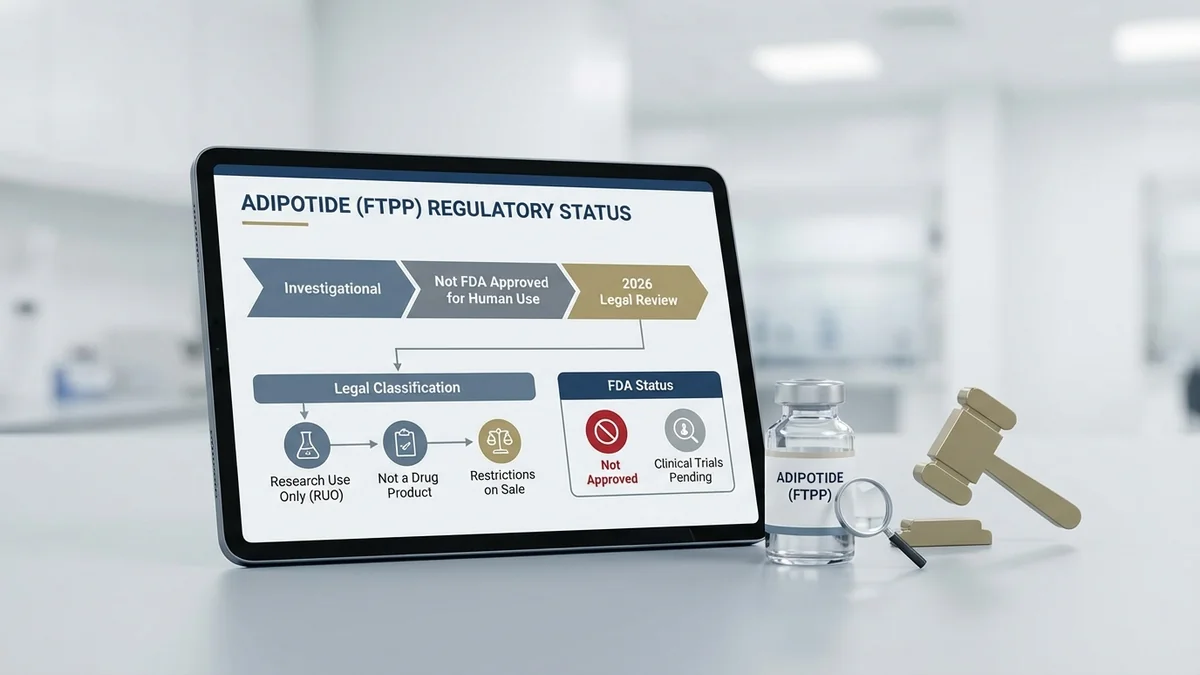
If you're researching ARA-290 legality, here's the short answer: ARA-290 is not FDA-approved for any clinical indication, and it's currently classified as a research-use-only compound in the United States. That means there's no legal pathway for a licensed physician to prescribe it, no licensed compounding pharmacy that can legally dispense it to patients, and no legitimate retail or online channel where you can buy it for personal use. What you'll find for sale is either a gray-market product or a research reagent that's not intended — and not legally permitted — for human administration.
That's the straight answer. But the full picture matters, because the regulatory situation around ARA-290 is genuinely interesting, the science behind it is promising, and the line between "research use" and "clinical use" gets blurry in ways that can get both patients and providers into legal trouble. This article breaks all of it down — FDA status, compounding rules, enforcement patterns, international status, and what you should actually do if you're a patient or provider trying to navigate this.
Key Takeaways
- ARA-290 has no FDA approval for any indication as of March 2026. It is classified as research-use only.
- No licensed compounding pharmacy can legally prepare ARA-290 for patient use under current FDA rules — it does not appear on the FDA's 503A bulk drug substance list as an approved compoundable substance.
- "Research use only" is not a loophole. Purchasing ARA-290 labeled for research and self-administering it is legally and medically risky.
- Prescribing ARA-290 to patients is not "off-label" prescribing — it's prescribing an unapproved drug, which carries distinct legal and liability implications for providers.
- The FDA actively monitors and enforces against companies marketing unapproved peptides, including research-only compounds, for human use.
- Promising clinical trial data exists, including Phase II studies in sarcoidosis-associated small fiber neuropathy, but regulatory approval remains years away at best.
Regulatory Status at a Glance
| Category | Status | Detail |
|---|---|---|
| FDA Approval | Not Approved | No approved indication for any clinical use as of March 2026 |
| FDA Compounding (503A/503B) | Not Listed / Not Permitted | Not on the FDA bulk drug substance list for compounding |
| DEA Scheduling | Not Scheduled | ARA-290 is not a controlled substance under the CSA |
| Prescription Availability | Not Available by Prescription | No legal Rx pathway exists for human use |
| Research Use | Permitted (Institutional)** | Available to licensed researchers under appropriate institutional oversight |
| EU/EMA Status | Not Approved | No marketing authorization in the European Union |
| UK MHRA Status | Not Approved | No marketing authorization in the United Kingdom |
| Australia TGA Status | Not Approved | Not listed on the Australian Register of Therapeutic Goods |
| Canada Health Canada | Not Approved | No Notice of Compliance issued |
Current FDA Status
ARA-290 is not FDA-approved. Full stop. There is no approved New Drug Application (NDA), no Biologics License Application (BLA), and no approved indication — not for pain, not for inflammation, not for neuropathy, not for anything.[1]
What ARA-290 actually is, pharmacologically, is a synthetic 11-amino-acid peptide engineered from the B-helix domain of erythropoietin (EPO). It binds selectively to the EPOR–CD131 heteroreceptor complex — sometimes called the innate repair receptor (IRR) — and activates tissue-protective signaling pathways without triggering erythropoiesis (red blood cell production).[2] That's the key distinction from EPO itself: ARA-290 was designed to capture EPO's cytoprotective and anti-inflammatory effects while eliminating the cardiovascular and hematological risks associated with erythropoietic stimulation.
That's scientifically interesting. It's also why ARA-290 has attracted legitimate clinical research interest, including a Phase II trial in sarcoidosis-associated small fiber neuropathy (SFN) that showed statistically significant improvements in corneal nerve fiber density and pain scores.[3] But interesting science and FDA approval are two very different things, and right now ARA-290 sits firmly in the "research compound" category.
The FDA classifies compounds like ARA-290 under its broader framework for unapproved drugs. Under the Federal Food, Drug, and Cosmetic Act (FD&C Act), a drug that lacks FDA approval cannot be legally marketed, sold, or distributed for human use in the United States — regardless of how promising the research looks.[1] The FDA has made clear through guidance documents and enforcement actions that research-use-only labeling on a product does not exempt it from these requirements if the product is intended for human consumption.
Compounding Status
This is where a lot of patients get confused, and understandably so. The compounding pathway — where licensed pharmacies under 503A or 503B of the FD&C Act prepare customized medications — has become a common route for peptides like BPC-157, TB-500, and others. So can a compounding pharmacy just make ARA-290?
No. Not legally.
For a compounding pharmacy to prepare a drug substance that isn't FDA-approved, that substance needs to appear on the FDA's bulk drug substance lists — either the 503A list (for traditional compounding pharmacies serving individual patients) or the 503B list (for outsourcing facilities producing larger batches).[4] ARA-290 does not appear on either list.
The FDA's bulk drug substance nomination process requires that a compound be evaluated for safety, clinical need, and whether it can be adequately compounded. Without that evaluation and listing, compounding pharmacies that prepare ARA-290 for patient administration are operating outside the law — and they risk FDA warning letters, injunctions, and other enforcement action.
This is meaningfully different from peptides like sermorelin or ipamorelin, which have established compounding pathways or FDA approval histories that inform current practice. ARA-290 has neither.
If you're at a clinic that's offering you compounded ARA-290 injections, ask them directly which compounding pharmacy is preparing it and whether that pharmacy is 503A or 503B registered. If they can't answer that question clearly, that's a serious red flag.
Enforcement Actions
The FDA has taken enforcement action against companies marketing unapproved peptide products for human use, including compounds classified as research-use only. These actions typically involve warning letters, import alerts, and — in more serious cases — referrals to the Department of Justice for criminal prosecution.[1]
For ARA-290 specifically, confirmed enforcement case details are not available in our current regulatory database. Rather than speculate, here's what we can tell you accurately: the FDA's enforcement posture toward unapproved research peptides has intensified since 2020, with particular scrutiny on compounds sold online with human dosing guidance, testimonials, or clinical claims. Companies that market ARA-290 with language like "supports nerve repair" or "reduces neuropathic pain" are making drug claims about an unapproved substance — that's a straightforward FD&C Act violation.
For current enforcement activity, consult FDA.gov's Warning Letters database and the FDA's MedWatch program. If you encounter a product making clinical claims about ARA-290, you can report it through the FDA's Safety Reporting Portal.
Prescription vs. Over-the-Counter vs. Research Use
Let's be clear about what each of these categories actually means for ARA-290.
Prescription: There is no legal prescription pathway for ARA-290 in the US. A physician writing a prescription for ARA-290 has no FDA-approved product to prescribe, no compounding pharmacy that can legally fill it, and no regulatory framework that authorizes the transaction. This isn't a technicality — it's a fundamental gap in the legal pathway.
Over-the-counter: ARA-290 is not available OTC. Any product sold directly to consumers without a prescription that contains ARA-290 and makes health claims is, by definition, an unapproved drug being marketed illegally.
Research use only: This is the category where ARA-290 actually lives — and it's more restricted than most people realize. "Research use only" (RUO) means the compound is sold for laboratory research, typically to institutions, universities, or licensed researchers conducting preclinical or clinical studies under Institutional Review Board (IRB) oversight and, where applicable, an FDA Investigational New Drug (IND) application.[1] It does not mean "you can buy it online and inject yourself." Purchasing an RUO compound and self-administering it doesn't make the act legal — it just means you're using a research reagent in a way it's not intended or authorized for.
Gray market products: These are the ARA-290 vials you'll find on various research chemical websites, often labeled "not for human consumption." The label is a legal fig leaf that doesn't actually protect buyers or sellers. If a product is being marketed with dosing protocols, before-and-after photos, or testimonials about human health outcomes, the FDA treats it as a drug regardless of the disclaimer. Buyers take on real legal risk — and unknown safety risk, since these products aren't subject to pharmaceutical-grade manufacturing standards.
International purchasing: Ordering ARA-290 from overseas for personal importation sits in a gray zone. The FDA's personal importation policy technically allows individuals to import small quantities of unapproved drugs for personal use under specific conditions, but those conditions include a licensed physician supervising your treatment — which, as established above, isn't a straightforward option with ARA-290.[1] Customs seizure is a real possibility, and the package won't come with a refund.
What "Off-Label" Actually Means
This distinction matters enormously, and it trips up a lot of providers who are new to peptide therapy.
Off-label prescribing is legal and common. An estimated 20% of all prescriptions in the United States are written for off-label uses — meaning a physician prescribes an FDA-approved drug for an indication, patient population, or dosage not specified in the FDA-approved labeling.[5] Physicians have broad discretion to do this, and it's a cornerstone of clinical practice.
But off-label prescribing only applies to FDA-approved drugs. ARA-290 is not FDA-approved for anything. So if a provider writes you a prescription for ARA-290, they're not engaging in off-label prescribing — they're prescribing an unapproved drug. That's a categorically different legal situation.
Prescribing an unapproved drug exposes providers to several risks: potential FDA enforcement action, state medical board disciplinary proceedings, and significantly elevated malpractice liability. If a patient experiences an adverse event from an unapproved compound, the provider's legal position is substantially weaker than it would be with an approved drug or even a properly compounded medication. Malpractice carriers may not cover claims arising from unapproved drug administration, and some explicitly exclude them.
If a clinic is offering you ARA-290 injections and framing it as "off-label" treatment, that framing is inaccurate. Ask them specifically how they're navigating the unapproved drug issue — not the off-label issue — and see what they say.
State-Level Variations
State-level regulation adds another layer to an already complex picture.
State pharmacy boards govern compounding pharmacies operating within their jurisdiction. While the FDA sets the federal framework for what can and can't be compounded, state boards have their own inspection and enforcement authority. A handful of states — including California, Florida, and Texas — have historically taken active positions on peptide compounding, issuing guidance or enforcement actions that go beyond federal minimums.
State medical boards regulate physician prescribing. A physician who prescribes ARA-290 in a state with an active medical board investigation into unapproved peptide prescribing faces a real risk of disciplinary action, regardless of whether federal enforcement materializes. Several state boards have issued guidance in the past three years specifically addressing unapproved research peptides.
Telemedicine adds complexity. Telehealth platforms have expanded access to peptide therapy clinics dramatically since 2020, and some operate across multiple states. The prescribing physician's state license, the patient's state of residence, and the compounding pharmacy's state registration all create overlapping jurisdictional questions. For an unapproved compound like ARA-290, this complexity doesn't create opportunity — it multiplies the legal exposure for everyone involved.
If you're using our clinic finder to locate a peptide therapy provider, ask any clinic you contact specifically about their compliance approach to unapproved compounds before sharing personal health information.
International Status
ARA-290's regulatory status outside the US follows a similar pattern: no approvals, active research interest, and no clear clinical pathway yet.
EU/EMA: The European Medicines Agency has not granted marketing authorization for ARA-290. It has been studied in European clinical trials, including research conducted in the Netherlands on sarcoidosis-associated SFN, but those trials operated under clinical trial authorization — not marketing approval.[3]
UK MHRA: The Medicines and Healthcare products Regulatory Agency has not approved ARA-290. Post-Brexit, the UK operates its own approval pathway, and ARA-290 hasn't entered it.
Australia TGA: ARA-290 is not listed on the Australian Register of Therapeutic Goods (ARTG). The TGA's Special Access Scheme (SAS) allows unapproved products to be accessed for individual patients in specific circumstances, but this requires physician application and TGA authorization — it's not a general consumer pathway.
Canada Health Canada: No Notice of Compliance has been issued for ARA-290. Canada's Special Access Program (SAP) similarly allows physician-requested access to unapproved drugs in exceptional cases, but this is a regulated, case-by-case process.
The practical takeaway for international purchasing: no jurisdiction makes it easy or clearly legal to obtain ARA-290 for personal clinical use. The research trials that have produced the most compelling data operated under formal institutional and regulatory oversight — not consumer access programs.