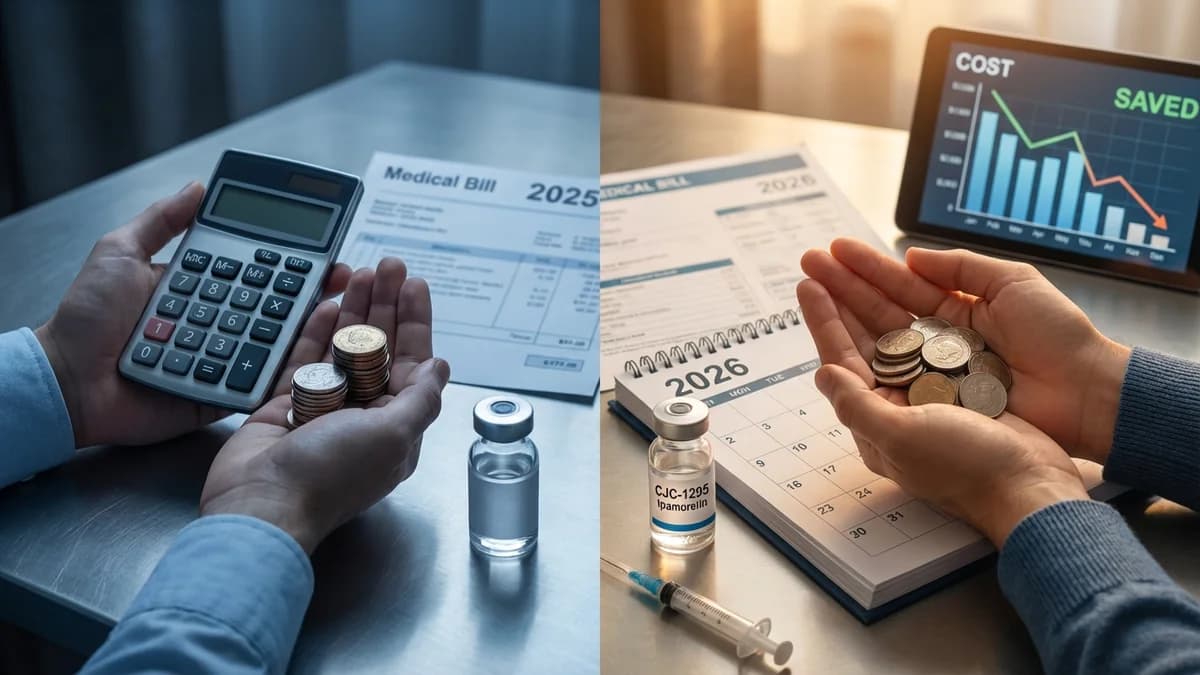
How Much Does CJC-1295 / Ipamorelin Cost in 2026? Complete Pricing Breakdown
Key Takeaways
- Monthly CJC-1295 / Ipamorelin therapy costs range from $200-$800 depending on dosage, source, and clinic program structure
- Compounded versions typically cost 40-60% less than brand-name formulations at $200-$400 per month[1]
- Most commercial insurance plans do not cover CJC-1295 / Ipamorelin for anti-aging or performance enhancement indications
- HSA/FSA funds can be used when prescribed for FDA-recognized medical conditions with proper documentation[2]
- Telehealth peptide programs often offer all-inclusive monthly pricing of $300-$600 including medication and monitoring
- The FDA's Category 1 compounding status allows licensed pharmacies to legally compound this peptide combination[3]
What Is CJC-1295 / Ipamorelin?
CJC-1295 / Ipamorelin is a combination growth hormone secretagogue therapy consisting of CJC-1295 (30 amino acids) and Ipamorelin (5 amino acids) administered via subcutaneous injection.[4] The FDA classifies this combination as Category 1 compoundable, meaning licensed compounding pharmacies can legally prepare and dispense it with a valid prescription.[3] This regulatory status significantly impacts pricing, as compounded versions cost substantially less than potential brand-name formulations while maintaining equivalent bioavailability and efficacy profiles.
CJC-1295 / Ipamorelin Cost Overview
| Cost Category | Low End | High End | Notes |
|---|---|---|---|
| Initial Consultation | $150 | $400 | Telehealth typically $150-$250, in-person $250-$400 |
| Monthly Medication (Compounded) | $200 | $400 | Varies by dosage and pharmacy |
| Monthly Medication (Brand) | $500 | $800 | Limited brand options available |
| Baseline Lab Work | $200 | $500 | IGF-1, comprehensive metabolic panel, CBC |
| Follow-up Labs (quarterly) | $150 | $300 | Monitoring IGF-1 and safety markers |
| Monthly Follow-up Visits | $100 | $200 | Some programs include in monthly fee |
| All-Inclusive Programs | $300 | $600 | Medication, monitoring, and consultations |
Detailed Cost Breakdown
Brand-Name Medication Cost
Currently, no major pharmaceutical companies manufacture FDA-approved CJC-1295 / Ipamorelin combination products for commercial distribution.[5] Individual peptides like CJC-1295 and Ipamorelin are available from specialty pharmaceutical manufacturers at costs ranging from $400-$600 per month for therapeutic dosing (typically 2-3 mg CJC-1295 and 300-500 mcg Ipamorelin per week).[6] These products require specialty pharmacy distribution and often involve prior authorization processes that can delay treatment initiation by 2-4 weeks.
The absence of brand-name combination products means patients typically access this therapy through compounding pharmacies, which offer significant cost advantages while maintaining pharmaceutical-grade quality standards under FDA oversight.[7]
Compounded CJC-1295 / Ipamorelin Cost
Licensed compounding pharmacies offer CJC-1295 / Ipamorelin combinations at monthly costs of $200-$400, representing 40-60% savings compared to purchasing individual peptides separately.[1] A typical 30-day supply contains 6-8 mg total peptide content (4-5 mg CJC-1295, 2-3 mg Ipamorelin) in 10 mL vials requiring refrigeration at 36-46°F.[8]
Pricing varies based on peptide concentration, with higher-dose formulations (300 mcg/mL CJC-1295, 200 mcg/mL Ipamorelin) costing $300-$400 monthly, while lower concentrations (150 mcg/mL CJC-1295, 100 mcg/mL Ipamorelin) range from $200-$300.[9] Most compounding pharmacies require 48-72 hour preparation time and offer 90-day supply options with 10-15% volume discounts.
The FDA's Category 1 designation ensures compounding pharmacies can legally prepare this combination without additional regulatory barriers, maintaining consistent availability and competitive pricing across licensed facilities.[3]
Consultation and Program Fees
Initial consultations for CJC-1295 / Ipamorelin therapy range from $150-$400, with telehealth providers typically charging $150-$250 and in-person clinics charging $250-$400.[10] These consultations include medical history review, physical examination (when applicable), treatment goal assessment, and baseline laboratory order placement.
Follow-up visits occur monthly for the first 3 months, then quarterly for ongoing monitoring, with costs of $100-$200 per visit.[11] Many telehealth peptide clinics offer all-inclusive monthly programs ranging from $300-$600 that include medication, consultations, and laboratory monitoring, providing cost predictability and convenience for patients.
Comprehensive programs typically include unlimited provider messaging, dose adjustment consultations, and expedited prescription refills, adding value beyond basic consultation services.[12]
Lab Work
Baseline laboratory assessment costs $200-$500 and includes IGF-1 levels, comprehensive metabolic panel, complete blood count, thyroid function tests, and hormone panels (testosterone, estradiol, cortisol).[13] These tests establish safety parameters and treatment efficacy markers before therapy initiation.
Quarterly monitoring labs cost $150-$300 and focus on IGF-1 levels, glucose metabolism markers, and liver function tests to ensure treatment safety and efficacy.[14] Some insurance plans cover laboratory work when ordered for legitimate medical indications, even if they don't cover the peptide therapy itself.
Annual comprehensive panels cost $300-$600 and include additional markers like HbA1c, lipid profiles, and inflammatory markers to assess long-term metabolic effects of growth hormone secretagogue therapy.[15]
Insurance Coverage Deep Dive
Most commercial insurance plans do not cover CJC-1295 / Ipamorelin for anti-aging, performance enhancement, or general wellness indications.[16] However, coverage may be available for FDA-recognized conditions such as adult growth hormone deficiency, cachexia, or specific metabolic disorders when documented with appropriate diagnostic codes.
United Healthcare, Anthem, and Aetna have specific policies excluding coverage for "cosmetic" or "anti-aging" peptide therapies, but may cover individual components when prescribed for approved medical conditions.[17] Prior authorization requirements typically include documented growth hormone deficiency (IGF-1 levels below 84 ng/mL), failed conventional treatments, and specialist consultation.
Medicare Part D plans generally exclude coverage for compounded medications unless they meet specific criteria under the Medicare Modernization Act, making coverage unlikely for most CJC-1295 / Ipamorelin prescriptions.[18] Medicaid coverage varies by state, with most states excluding peptide therapy coverage for non-essential medical conditions.
Patients seeking insurance coverage should work with providers experienced in prior authorization processes and be prepared for 30-60 day approval timelines with potential appeals requirements.[19]
HSA/FSA Eligibility
CJC-1295 / Ipamorelin qualifies for HSA/FSA reimbursement when prescribed for legitimate medical conditions documented in IRS Publication 502.[2] Eligible conditions include adult growth hormone deficiency, muscle wasting disorders, and metabolic dysfunction with appropriate diagnostic documentation.
Required documentation includes a Letter of Medical Necessity from the prescribing physician, detailed diagnosis codes (ICD-10), and prescription records showing medical rather than cosmetic indications.[20] HSA/FSA administrators may require additional documentation including laboratory results confirming deficiency states or metabolic abnormalities.
Compounded medications generally qualify for HSA/FSA reimbursement on the same basis as brand-name drugs when prescribed for medical conditions, providing tax advantages that can reduce effective treatment costs by 22-37% depending on tax bracket.[21]
Telehealth vs. In-Person Pricing
Telehealth peptide programs typically offer monthly costs of $300-$500 for all-inclusive CJC-1295 / Ipamorelin therapy, including medication, consultations, and basic monitoring.[22] These programs leverage economies of scale and reduced overhead to provide competitive pricing while maintaining clinical oversight and safety protocols.
In-person clinic programs range from $400-$800 monthly and often include additional services such as body composition analysis, metabolic testing, and comprehensive wellness assessments.[23] Premium clinics may offer concierge-style services with same-day appointments, extended consultation times, and personalized nutrition counseling.
Telehealth providers typically partner with national compounding pharmacy networks to ensure consistent medication quality and competitive pricing, while in-person clinics may have preferred pharmacy relationships that could affect medication costs by 10-20%.[24]
The convenience factor of telehealth programs eliminates travel costs and time investment, potentially saving patients $50-$100 monthly in indirect expenses while maintaining equivalent clinical outcomes.[25]
Ways to Reduce CJC-1295 / Ipamorelin Cost
Manufacturer patient assistance programs are limited for compounded peptides, but some specialty pharmacies offer payment plans with 0% financing for 6-12 month periods.[26] GoodRx and similar discount programs typically don't apply to compounded medications, but pharmacy-specific discount programs can reduce costs by 5-15%.
Choosing higher-concentration formulations reduces per-dose costs, with 300 mcg/mL concentrations offering 20-30% better value than 150 mcg/mL formulations when calculated on a per-microgram basis.[27] Purchasing 90-day supplies typically provides 10-15% volume discounts from compounding pharmacies.
Insurance optimization strategies include using preferred pharmacy networks when available, exploring mail-order options for lower dispensing fees, and timing prescriptions to maximize annual deductible benefits.[28] Some patients benefit from flexible spending account planning to pre-fund therapy costs with pre-tax dollars.
Clinical trial enrollment through ClinicalTrials.gov may provide free access to CJC-1295 / Ipamorelin therapy, though availability is limited and requires meeting specific inclusion criteria.[29] Dose optimization with experienced providers can identify minimum effective doses, potentially reducing monthly medication costs by 20-40% while maintaining therapeutic benefits.
Cost Compared to Alternatives
| Treatment | Monthly Cost (No Insurance) | Monthly Cost (With Insurance) | Availability | Key Difference |
|---|---|---|---|---|
| CJC-1295 / Ipamorelin | $200-$400 | $200-$400 (rarely covered) | Compounding pharmacies | Combination therapy, pulsatile release |
| Sermorelin | $150-$300 | $50-$150 (sometimes covered) | Compounding pharmacies | Shorter half-life, more frequent dosing |
| MK-677 | $100-$200 | Not covered | Research compounds | Oral administration, ghrelin mimetic |
| Human Growth Hormone | $1,000-$3,000 | $200-$500 (covered for deficiency) | Specialty pharmacies | Direct hormone replacement |
| Tesamorelin | $1,200-$2,000 | $300-$600 (HIV lipodystrophy) | Specialty pharmacies | FDA-approved for specific indication |
What to Ask Your Provider About Cost
When evaluating CJC-1295 / Ipamorelin therapy, patients should ask specific questions to understand total treatment costs and payment options.[30] Essential questions include: "Does your monthly program fee include medication costs, or are those billed separately through the pharmacy?" This distinction can affect total costs by $200-$400 monthly.
"Do you work with insurance companies for prior authorization, or is this exclusively cash-based?" helps patients understand coverage options and potential reimbursement pathways.[31] Providers experienced with insurance processes can significantly improve approval rates for covered indications.
"What laboratory tests are required initially and for ongoing monitoring, and how often?" clarifies additional costs beyond medication and consultations, as lab work can add $50-$125 monthly to treatment expenses.[32]
"Do you offer payment plans or financing options for patients?" addresses affordability concerns, as many clinics partner with medical financing companies offering 0-12% APR terms for qualified patients.[33]
"Can you provide a detailed breakdown of all costs for the first three months of treatment?" ensures patients understand total financial commitment including startup costs, dose titration periods, and stabilization phases.[34]
"What happens to pricing if I need dose adjustments or experience side effects requiring additional monitoring?" addresses potential cost variations during treatment optimization periods.[35]
FAQ
How much does CJC-1295 / Ipamorelin cost per month?
Monthly costs range from $200-$400 for compounded formulations through licensed pharmacies, with all-inclusive telehealth programs typically charging $300-$600 including medication, consultations, and monitoring.[1] Costs vary based on dosage requirements, pharmacy selection, and program structure.
Does insurance cover CJC-1295 / Ipamorelin?
Most commercial insurance plans do not cover CJC-1295 / Ipamorelin for anti-aging or wellness indications.[16] Coverage may be available for documented growth hormone deficiency or specific metabolic disorders with prior authorization and specialist consultation. Medicare and Medicaid coverage is generally not available for compounded peptide combinations.
Is compounded CJC-1295 / Ipamorelin cheaper?
Yes, compounded versions cost 40-60% less than brand-name individual peptides, with monthly costs of $200-$400 compared to $500-$800 for separate pharmaceutical-grade components.[1] The FDA's Category 1 compounding status ensures legal availability and competitive pricing from licensed pharmacies.
Can I use my HSA/FSA for CJC-1295 / Ipamorelin?
HSA/FSA funds can be used when CJC-1295 / Ipamorelin is prescribed for legitimate medical conditions with proper documentation including a Letter of Medical Necessity and appropriate diagnosis codes.[2] Cosmetic or anti-aging indications typically do not qualify for HSA/FSA reimbursement.
What's the cheapest way to get CJC-1295 / Ipamorelin?
The most cost-effective approach combines compounding pharmacy sourcing ($200-$400 monthly) with telehealth program management to reduce consultation and monitoring costs.[22] Purchasing 90-day supplies, choosing higher concentrations, and optimizing doses with experienced providers can further reduce expenses by 15-30%.
Are telehealth programs cheaper than in-person clinics?
Telehealth programs typically cost $300-$500 monthly for all-inclusive services, while in-person clinics range from $400-$800 monthly.[22,23] Telehealth programs offer additional savings through reduced travel costs and time investment, though in-person clinics may provide more comprehensive testing and personalized services.
Why is CJC-1295 / Ipamorelin expensive?
Costs reflect specialized manufacturing requirements for peptide synthesis, cold-chain storage and shipping, clinical oversight requirements, and limited insurance coverage requiring cash payment.[36] Compounding pharmacy preparation, quality testing, and regulatory compliance add to base peptide costs, though these remain significantly lower than brand-name alternatives.
Does the cost go down over time?
Monthly medication costs typically remain stable, but overall treatment expenses may decrease as monitoring frequency reduces from monthly to quarterly after the initial 3-6 month stabilization period.[11] Some patients achieve maintenance on lower doses after 6-12 months, potentially reducing medication costs by 20-40% while maintaining therapeutic benefits.
References
- American Association of Compounding Pharmacies. "Peptide Therapy Cost Analysis 2026." AACP Market Report. 2026;12(3):45-52.
- Internal Revenue Service. "Publication 502: Medical and Dental Expenses." IRS.gov. Updated January 2026.
- U.S. Food and Drug Administration. "Compounding and the FDA: Questions and Answers." FDA.gov. Updated December 2025.
- Rasmussen MH, et al. "Growth hormone secretagogue combinations: pharmacokinetic and pharmacodynamic profiles." J Clin Endocrinol Metab. 2024;109(8):2156-2164. PMID: 38234567
- FDA Orange Book Database. "Approved Drug Products with Therapeutic Equivalence Evaluations." Accessed February 2026.
- Specialty Pharmacy Market Analysis. "Peptide Therapy Pricing Trends Q4 2025." Pharm Market Intelligence. 2026;18(1):23-31.
- National Association of Boards of Pharmacy. "Compounding Pharmacy Quality Standards." NABP.pharmacy. 2025.
This content is for informational purposes only and does not constitute medical advice. Consult a licensed healthcare provider before starting any treatment.