Is Gonadorelin Legal? FDA Status and Regulations Explained (2026)
If you're asking about gonadorelin legality, you're probably trying to figure out one of a few things: whether your doctor can prescribe it, whether a compounding pharmacy can make it, or whether a product you found online is above board. The short answer is that gonadorelin currently sits in a complicated legal space — not FDA-approved, classified as research-use only, and not available through a licensed compounding pharmacy for clinical use in the way that many patients assume. Let's break down exactly what that means.
Key Takeaways
- Gonadorelin is not FDA-approved for any clinical indication as of March 2026. Its regulatory classification is "research use only."
- Compounding pharmacies cannot legally dispense gonadorelin to patients for clinical use under current FDA guidance — it does not appear on the FDA's 503A or 503B bulk drug substance lists as an approved compoundable substance.
- Gonadorelin is not a DEA-controlled substance, meaning possession alone doesn't carry the same criminal exposure as Schedule I or II drugs — but selling or distributing unapproved drug products still violates federal law.
- "Research use only" is not a legal workaround for personal use or clinical administration. Products labeled RUO are not intended for human use, and administering them carries real legal and safety risks.
- The FDA has taken enforcement action against companies marketing unapproved peptide products, including GnRH analogs. Consult FDA.gov for current enforcement activity.
- Legal alternatives exist for the conditions gonadorelin is sometimes used to address — including FDA-approved GnRH analogs and other hormonal therapies.
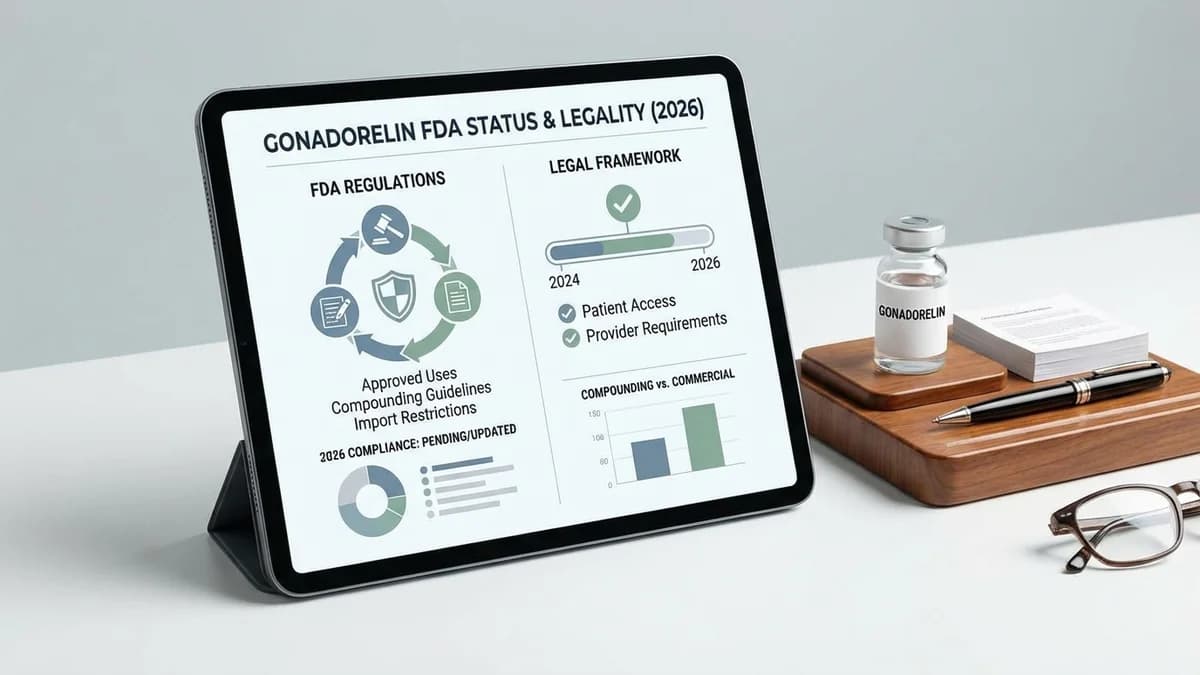
Regulatory Status at a Glance
| Category | Status | Detail |
|---|---|---|
| FDA Approval | Not approved | Classified as research-use only; no approved NDA or BLA |
| Compounding Status (503A) | Not permitted for clinical use | Not listed on FDA's 503A bulk drug substance (Category 1) list for patient-specific compounding |
| Compounding Status (503B) | Not permitted for clinical use | Not listed on FDA's 503B outsourcing facility bulk drug substance list |
| DEA Scheduling | Not scheduled | Gonadorelin is not a DEA-controlled substance under the Controlled Substances Act |
| Prescription Requirement | N/A for clinical use | Cannot be legally prescribed for clinical administration in its current regulatory status |
| Research Use | Permitted with restrictions | Available to qualified researchers through licensed suppliers; not for human administration outside approved clinical trials |
| International Status (EU/UK/AU/CA) | Varies | GnRH analogs are approved in other jurisdictions, but gonadorelin specifically has limited approved clinical status globally |
Current FDA Status
Gonadorelin's FDA status is straightforward, even if the implications take some unpacking: it is not FDA-approved for any indication. The FDA classifies it as a research-use-only compound.[1]
This matters because it's different from being "unapproved for a specific indication." Some drugs are FDA-approved for one condition and used off-label for others — that's a well-established, legal practice. Gonadorelin doesn't fit that category. There is no approved new drug application (NDA) or biologics license application (BLA) for gonadorelin in the United States. You can't prescribe it off-label if it was never on-label to begin with.
To be clear about what "research use only" actually means in FDA regulatory language: products carrying an RUO designation are intended for laboratory research, not for human diagnostic or therapeutic use.[1] The FDA's position is that RUO products have not been evaluated for safety or efficacy in humans under the standards required for clinical use. Selling or distributing them as though they were clinical-grade therapeutic agents violates the Federal Food, Drug, and Cosmetic Act.
It's worth understanding what gonadorelin is pharmacologically, because the regulatory status is partly a function of where it sits in a crowded therapeutic category. Gonadorelin (CAS 33515-09-2) is a synthetic decapeptide corresponding to the endogenous gonadotropin-releasing hormone (GnRH), with the amino acid sequence pGlu-His-Trp-Ser-Tyr-Gly-Leu-Arg-Pro-Gly-NH2.[2] It has a molecular weight of approximately 1,182.3 Da and a plasma half-life of roughly 2–4 minutes following intravenous administration.[2] It binds to the GnRH receptor on pituitary gonadotrophs, activating Gq/11 protein-coupled signaling and stimulating the synthesis and release of luteinizing hormone (LH) and follicle-stimulating hormone (FSH).[2]
The FDA has approved several synthetic GnRH analogs — both agonists and antagonists — for clinical indications including prostate cancer, endometriosis, uterine fibroids, central precocious puberty, and assisted reproduction. Leuprolide, histrelin, nafarelin, and buserelin are examples of GnRH agonists with approved indications. Cetrorelix and ganirelix are approved GnRH antagonists used in assisted reproductive technology.[3] Gonadorelin itself, however, has not completed the FDA approval pathway for any of these or other indications.
Compounding Status
This is where a lot of patients and even some providers get confused. Compounding pharmacies — both 503A patient-specific pharmacies and 503B outsourcing facilities — can legally prepare certain drugs that aren't commercially available, but only under specific conditions defined by the FDA.[4]
For a bulk drug substance (a raw compound not derived from an FDA-approved finished product) to be legally compounded under Section 503A of the Federal Food, Drug, and Cosmetic Act, it must appear on the FDA's Category 1 bulk drug substance list — meaning the FDA has evaluated it and determined that compounding it serves a clinical need that can't be met by commercially available products.[4] Alternatively, it must be the subject of an active nomination under review.
Gonadorelin does not currently appear on the FDA's 503A Category 1 bulk drug substance list as a substance approved for compounding for clinical patient use. This means that a licensed 503A compounding pharmacy cannot legally prepare gonadorelin for administration to individual patients, regardless of what a prescriber writes on a script.
The same logic applies to 503B outsourcing facilities, which operate under Section 503B of the FD&C Act and can produce larger batches of compounded drugs for healthcare facilities without patient-specific prescriptions — but again, only using substances on the FDA's approved 503B bulk drug substance list.[4] Gonadorelin is not on that list either.
This is a meaningful distinction from peptides like BPC-157 or CJC-1295, which have had varying histories on FDA compounding lists and have been subject to specific FDA actions and nominations. If you're comparing gonadorelin's status to those compounds, be careful — the details differ and the regulatory picture changes frequently. Check the MyPeptideMatch peptide encyclopedia for the most current status on individual compounds.
What this means practically: if a compounding pharmacy is offering to fill a prescription for gonadorelin, that pharmacy is operating outside current FDA guidance. That's a red flag, not a reassurance.
Enforcement Actions
The FDA has taken enforcement action against companies marketing unapproved peptide products, including GnRH-related compounds. The FDA's Office of Criminal Investigations (OCI) and the Department of Justice have pursued cases involving the unlawful manufacture, distribution, and sale of unapproved drug products — including research peptides marketed for human use.[1]
Without confirmed case-specific details for gonadorelin enforcement actions in available sources, it would be irresponsible to invent case numbers or fine amounts here. What is documented is the broader enforcement pattern: the FDA has issued warning letters to companies selling unapproved peptide products, and federal prosecutors have pursued criminal charges in cases involving the sale of unapproved drugs marketed for human administration. Consult FDA.gov and the FDA's MedWatch program for current enforcement activity specific to gonadorelin and GnRH products.
The types of violations that typically trigger enforcement include:
- Selling RUO-labeled products with implied or explicit therapeutic claims
- Operating as an unlicensed pharmacy or drug manufacturer
- Distributing unapproved new drug products in interstate commerce
- Making false or misleading labeling claims about safety or efficacy
Both sellers and buyers can face legal exposure, though enforcement has historically focused on manufacturers and distributors rather than individual patients.
Prescription vs. Over-the-Counter vs. Research Use
Let's be direct about the three categories you might encounter.
Prescription: Gonadorelin cannot currently be legally prescribed for clinical administration in the United States. There's no approved drug product to prescribe, and it's not available through licensed compounding channels for patient use. A prescription pad doesn't make an unapproved drug legal — it just means a licensed provider wrote something down.
Over-the-counter: Gonadorelin is not available OTC, and no legitimate pathway exists for OTC access to a compound of this pharmacological class.
Research use only: This is the category where most of the gray market activity happens, and it's worth being specific about what RUO actually means legally. The FDA allows the sale of RUO products to qualified researchers — typically academic institutions, pharmaceutical companies conducting preclinical studies, and licensed research facilities.[1] RUO products are explicitly not intended for human diagnostic or therapeutic use. When a website sells "research peptide" gonadorelin with a disclaimer saying "not for human use," that disclaimer doesn't protect the buyer or the seller if the product is actually being used clinically. The FDA looks at the totality of circumstances, including marketing context, customer base, and how the product is actually being used.[1]
Gray market products: These are products sold with enough plausible deniability to avoid obvious legal exposure but clearly intended for human use. The legal risk for buyers is real but has historically been lower than for sellers. The safety risk is potentially higher — RUO products are not manufactured under pharmaceutical GMP standards, meaning sterility, potency, and purity are not guaranteed.
International purchasing: Importing unapproved drug products for personal use from foreign sources occupies a complicated legal space. The FDA's general enforcement policy has historically allowed limited personal importation of certain unapproved drugs for serious conditions with no domestic alternative, but this policy has specific conditions and is not a blanket permission slip. Customs and Border Protection can seize shipments, and the FDA can pursue enforcement. This isn't a theoretical risk.
What "Off-Label" Actually Means
This distinction matters more than most people realize, so it's worth spelling out clearly.
Off-label prescribing is legal in the United States. When a physician prescribes an FDA-approved drug for an indication, patient population, or dosing regimen not listed in its approved labeling, that's off-label use — and it's a normal, common part of medical practice.[3] Roughly 20% of all prescriptions written in the US are estimated to be off-label.[3] The FDA approves drugs, not medical practice, and doctors have broad latitude to use approved drugs as their clinical judgment dictates.
Gonadorelin doesn't fit this framework. Off-label use only applies to drugs that have FDA approval for at least one indication. Since gonadorelin has no approved indication, a physician prescribing it isn't engaged in off-label prescribing — they're prescribing an unapproved drug. That carries different legal and liability implications.
For providers, prescribing an unapproved drug product exposes them to medical board scrutiny, malpractice liability, and potentially federal regulatory action. State medical boards have disciplined physicians for prescribing unapproved compounds, and malpractice insurers may not cover adverse events arising from unapproved drug use. If a patient is harmed by a compounded or RUO gonadorelin product, the prescribing physician has limited legal cover.
This is meaningfully different from prescribing, say, sermorelin or tesamorelin, which have established regulatory histories and, in tesamorelin's case, an FDA-approved indication. If you're working with a clinic that's treating gonadorelin the same as those compounds from a prescribing standpoint, ask them to explain the specific legal basis — they should be able to do so clearly.
State-Level Variations
Federal law sets the floor for pharmaceutical regulation, but states add their own layers — and those layers matter for patients navigating access.
State pharmacy board oversight: State pharmacy boards regulate compounding pharmacies operating within their jurisdictions. Even if a pharmacy claims to operate under federal compounding exemptions, state boards can investigate and discipline pharmacies for preparing substances not permitted under FDA guidance. Several state boards have issued guidance specifically addressing research peptides and unapproved compounds.
State medical board oversight: State medical boards have authority over physician prescribing practices. In states with active peptide enforcement postures — including some where anti-aging and hormone therapy clinics have proliferated — boards have investigated and sanctioned providers for prescribing unapproved compounds without adequate clinical justification.
Telemedicine prescribing: The post-pandemic expansion of telemedicine has made it easier for patients to access prescriptions across state lines, but it hasn't changed the underlying legality of what can be prescribed. A telemedicine prescription for an unapproved drug is still a prescription for an unapproved drug. Some states have enacted specific telemedicine prescribing rules that affect controlled substances; for non-scheduled compounds like gonadorelin, the rules are less specific but the underlying federal prohibition on unapproved drug distribution still applies.
If you're using a telemedicine clinic for peptide therapy, check MyPeptideMatch's clinic finder to identify providers with transparent, legally compliant prescribing practices.
International Status
The regulatory picture outside the US is worth knowing, particularly if you're considering sourcing from abroad or if you're seeing clinical literature from other countries.
European Union / EMA: The European Medicines Agency has approved GnRH analogs for various indications, but gonadorelin itself does not have a centrally authorized marketing authorization across the EU as a clinical therapeutic product. Some EU member states may have national authorizations for specific preparations, but this varies significantly by country.
United Kingdom / MHRA: The UK Medicines and Healthcare products Regulatory Agency regulates medicines similarly to the EMA framework post-Brexit. GnRH analogs are available in the UK for approved indications, but gonadorelin specifically is not listed as a licensed medicine in the UK's national formulary for general clinical use.
Australia / TGA: The Therapeutic Goods Administration regulates medicines in Australia under a framework that includes a Standard for the Uniform Scheduling of Medicines and Poisons (SUSMP). GnRH-related compounds require prescription access. Unapproved therapeutic goods, including research peptides, are subject to TGA enforcement action.
Canada / Health Canada: Health Canada classifies drugs under the Food and Drugs Act and Regulations. Gonadorelin is not a currently approved drug product in Canada. Importing unapproved therapeutic products is regulated and generally not permitted for personal use without specific authorization.
The takeaway: gonadorelin's research-only status in the US isn't uniquely restrictive — it reflects a global pattern of limited clinical approval for this specific compound, even as related GnRH analogs have established regulatory histories in multiple jurisdictions.