Is Tesamorelin, CJC-1295 (no DAC), Ipamorelin 12mg (Blend) Legal? FDA Status and Regulations Explained (2026)
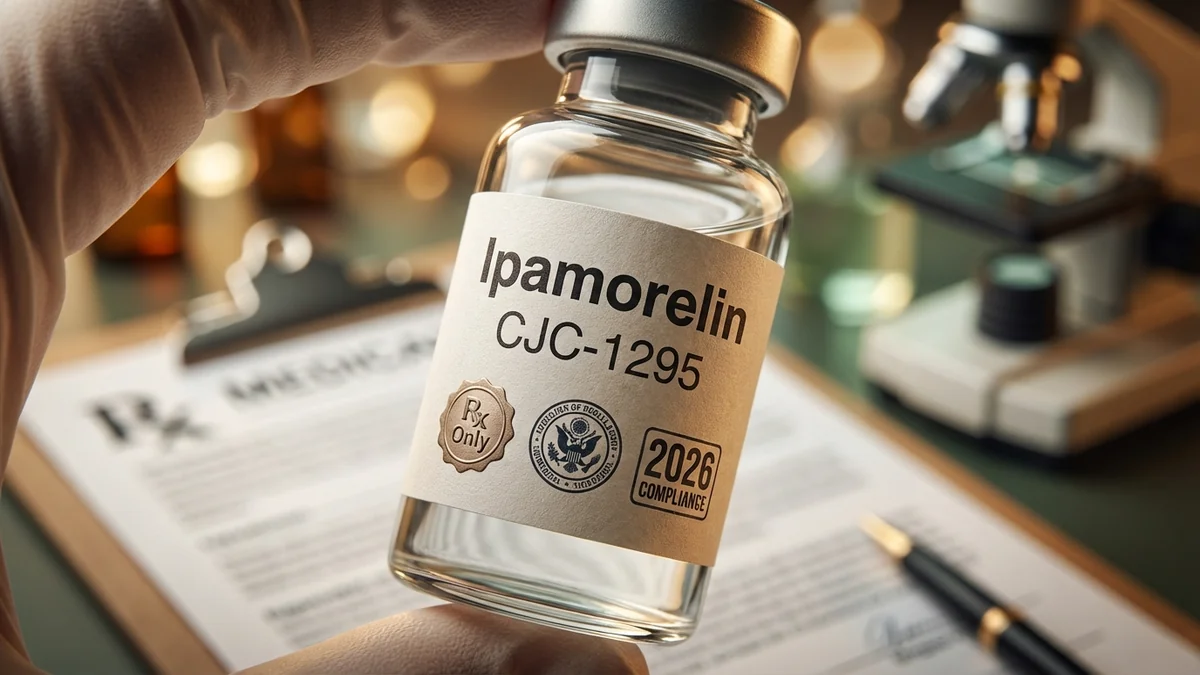
If you're researching the Tesamorelin, CJC-1295 (no DAC), Ipamorelin 12mg (Blend) legality question, here's the short answer: this specific triple-peptide blend is not FDA-approved for any clinical indication and is classified as research use only. That means a licensed physician cannot legally prescribe it to you, a compounding pharmacy cannot legally prepare it for human use, and buying it online — regardless of what the seller's website says — puts you in a genuine legal grey zone. The longer answer involves understanding how each of the three component peptides sits within the regulatory framework, why the FDA draws the lines it does, and what your actual options are if you're pursuing growth hormone axis optimization through a legitimate clinic.
This article breaks all of that down, component by component and regulation by regulation, so you can make an informed decision rather than guessing.
Key Takeaways
- The Tesamorelin, CJC-1295 (no DAC), Ipamorelin 12mg Blend is not FDA-approved for any human clinical indication and carries a research use only classification as of March 2026.[1]
- Tesamorelin as a standalone drug (brand name EGRIFTA SV®) holds FDA approval specifically for HIV-associated lipodystrophy, but this approval does not extend to blended formulations with CJC-1295 or Ipamorelin.[2]
- CJC-1295 (no DAC) and Ipamorelin individually appeared on the FDA's 503B bulk drug substance "Category 2" list — meaning the FDA has determined they present known safety risks that preclude their use in compounded preparations intended for human use.[3]
- Vendors selling this blend as "research use only" are not providing a legal loophole — that label does not authorize human use and does not protect buyers from legal or health risk.
- No DEA scheduling currently applies to this blend, but that does not make it legal for human use; it simply means a different regulatory framework (FDA drug approval and compounding law) governs it.
- If you're working with a clinic offering this blend for human administration, that's a significant red flag. Ask hard questions before proceeding.
Regulatory Status at a Glance
| Category | Status | Detail |
|---|---|---|
| FDA Approval (Blend) | Not Approved | No NDA, BLA, or ANDA exists for this triple-peptide formulation |
| FDA Approval (Tesamorelin standalone) | Approved (limited indication) | Egrifta SV® approved for HIV-associated lipodystrophy only; does not extend to blends[2] |
| FDA Approval (CJC-1295 no DAC) | Not Approved | No approved human indication |
| FDA Approval (Ipamorelin) | Not Approved | No approved human indication |
| Compounding Status (503A/503B) | Prohibited for human compounding | CJC-1295 and Ipamorelin on FDA Category 2 bulk substance list[3] |
| DEA Scheduling | Not Scheduled | Not a controlled substance under the CSA |
| Prescription Availability | Not legally prescribable as a blend | No approved indication; prescribing constitutes dispensing an unapproved drug |
| Research Use | Permitted (non-human/in vitro) | Legal for licensed research institutions under proper protocols |
| OTC Availability | Prohibited | Cannot be sold OTC for human use |
| International Status | Varies by jurisdiction | Generally restricted; see International Status section |
Current FDA Status
The regulatory picture here is more complicated than a simple yes/no — and that complexity is exactly what some clinics and vendors exploit. Let's separate the three components.
Tesamorelin
Tesamorelin (CAS 218949-48-5) is a 44-amino acid synthetic analog of growth hormone-releasing hormone (GHRH). It's the only component of this blend with any FDA approval at all. The FDA approved tesamorelin injection under the brand name Egrifta® in November 2010, and the reformulated version Egrifta SV® received approval in 2019, specifically for the reduction of excess abdominal fat in HIV-infected patients with lipodystrophy.[2] That indication is narrow and specific. The approval does not cover general body composition improvement, anti-aging applications, athletic performance, or any indication in non-HIV patients.
Critically, the FDA approval for Egrifta SV® applies to that specific manufactured product — not to tesamorelin as an active pharmaceutical ingredient that any pharmacy can freely compound. When tesamorelin is mixed into a multi-peptide blend, the resulting formulation has no FDA approval whatsoever.
CJC-1295 (No DAC)
CJC-1295 without Drug Affinity Complex (also called Modified GRF 1-29, or Mod GRF 1-29) is a truncated, stabilized GHRH analog. It has no FDA-approved indication for any condition.[1] The FDA evaluated CJC-1295 as part of its bulk drug substance review process for compounding pharmacies and determined it does not meet the criteria for inclusion on the list of substances that can be compounded for human use. The agency's concern centers on the lack of clinical safety data and the potential for immunogenicity — meaning the body may generate antibodies against synthetic peptide analogs, with unpredictable downstream consequences.[3]
Ipamorelin
Ipamorelin (CAS 170851-70-4) is a pentapeptide ghrelin mimetic and selective growth hormone secretagogue receptor (GHS-R1a) agonist. Like CJC-1295, it has no FDA-approved human indication and has been evaluated — and excluded — from the FDA's list of bulk drug substances that can be compounded.[3] The FDA's reasoning for both peptides follows the same logic: insufficient human safety data, no approved drug application, and concerns about immunogenicity risk in compounded injectable preparations.
The Blend as a Whole
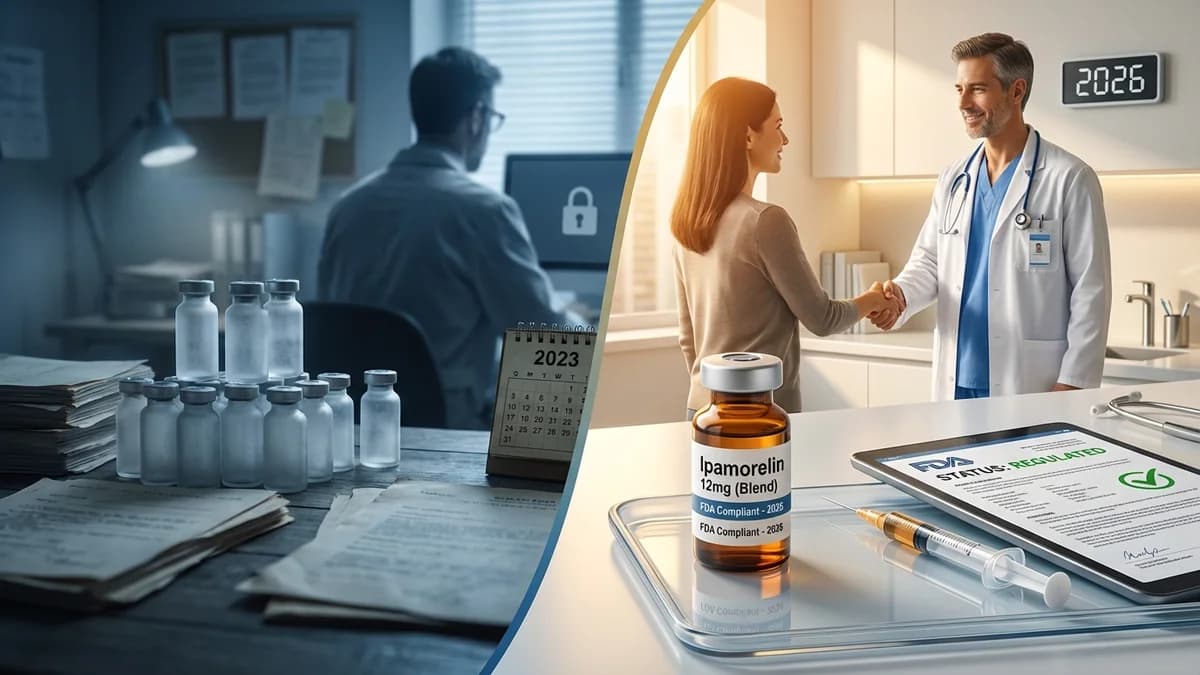
A formulation combining all three — tesamorelin, CJC-1295 (no DAC), and ipamorelin at a combined 12mg dose — has no regulatory pathway that makes it legal for human clinical use in the United States as of March 2026. The presence of FDA-approved tesamorelin in the mixture does not "upgrade" the blend's legal status. If anything, combining an approved drug with unapproved components creates additional regulatory complications.
Compounding Status
This is where most of the confusion in the peptide therapy space originates. Compounding pharmacies operate under two main regulatory frameworks: Section 503A of the Federal Food, Drug, and Cosmetic Act (FD&C Act), which covers traditional patient-specific compounding, and Section 503B, which covers outsourcing facilities that can produce larger batches without individual prescriptions.[4]
Both pathways require that the bulk drug substances used in compounding appear on an FDA-approved list, are components of an FDA-approved drug, or meet specific criteria established by the agency. The FDA has been working through a formal review process to evaluate peptides for inclusion or exclusion from these lists.
CJC-1295 and Ipamorelin: Category 2 Status
The FDA placed both CJC-1295 and Ipamorelin on the Category 2 bulk drug substance list — the list of substances that the FDA has evaluated and determined should not be used in compounded preparations.[3] Category 2 placement is not a temporary hold or a "pending" status. It reflects an affirmative FDA determination that the substance presents safety concerns or lacks sufficient evidence to support compounding for human use.
The specific concerns the FDA has raised about peptide secretagogues in this category include:
- Immunogenicity risk: Synthetic peptide analogs can trigger antibody formation, potentially causing hypersensitivity reactions or neutralizing the therapeutic effect of endogenous hormones.[3]
- Lack of adequate clinical data: Neither peptide has completed Phase III clinical trials establishing safety and efficacy in humans at the doses used in compounded preparations.
- Sterility and stability concerns: Injectable compounded peptides carry inherent sterility risks that are amplified when clinical evidence for the formulation is absent.
What This Means for 503A Pharmacies
A 503A compounding pharmacy — the kind that fills individual patient prescriptions — cannot legally compound CJC-1295 (no DAC) or Ipamorelin for human use under current FDA guidance. A pharmacy that does so is operating outside the regulatory framework, and both the pharmacy and the prescribing provider are exposed to regulatory and legal liability.
What This Means for 503B Outsourcing Facilities
503B outsourcing facilities face the same restriction. These facilities can produce large batches of compounded drugs for healthcare facilities, but only using substances on the approved list. CJC-1295 and Ipamorelin are not on that list.
Tesamorelin Compounding
Tesamorelin occupies a different position. Because Egrifta SV® is an FDA-approved drug, there are limited circumstances under which compounding pharmacies might compound tesamorelin — primarily when a patient has a documented clinical need that the commercially available product cannot meet (e.g., a specific allergen sensitivity to an excipient). However, compounding tesamorelin into a multi-peptide blend with unapproved substances is not a recognized legal pathway.
Enforcement Actions
The FDA has taken enforcement action against companies marketing unapproved peptide products, including growth hormone secretagogues. Patients and providers should consult FDA.gov and the FDA's MedWatch program for current enforcement activity related to this class of compounds.[1]
What the general enforcement pattern looks like, based on publicly available FDA activity:
- The FDA has issued warning letters to compounding pharmacies and online vendors marketing CJC-1295, Ipamorelin, and related peptides for human use without an approved application.
- The FDA's Office of Criminal Investigations (OCI) has coordinated with the Department of Justice on cases involving the distribution of unapproved injectable drugs, including peptide secretagogues.
- The Federal Trade Commission (FTC) has taken action against vendors making unsubstantiated health claims about peptide products marketed directly to consumers.
The enforcement risk falls most heavily on sellers and prescribers, not individual patients possessing small quantities for personal use — but that doesn't mean patients face zero risk, particularly when importing from overseas.
Prescription vs. Over-the-Counter vs. Research Use
Can a Doctor Prescribe This Blend?
No. A physician can legally prescribe an FDA-approved drug for an off-label use — that's a well-established medical and legal practice. But the Tesamorelin, CJC-1295 (no DAC), Ipamorelin 12mg Blend is not FDA-approved for any indication. Prescribing it isn't "off-label" — it's prescribing an unapproved drug, which is a different legal category entirely. (More on this distinction in the next section.)
A physician could, in theory, prescribe Egrifta SV® (standalone tesamorelin) off-label for a non-HIV patient, though that carries its own liability considerations and insurance won't cover it. But that's a separate product from this blend.
"Research Use Only" — Not a Loophole
Vendors selling this blend labeled "for research use only" or "not for human consumption" are not providing you a legal shield. That label is a seller's attempt to sidestep FDA drug regulations by framing the product as a laboratory chemical rather than a drug. The FDA evaluates products based on their intended use, not just their label. If a product is being sold with the understanding — even implicit — that buyers will use it on themselves, the FDA can and does treat it as an unapproved drug.[1]
From a practical standpoint: buying a "research use only" peptide blend online, injecting it yourself, and telling a customs agent "it's for research" is not a legal defense. It's also genuinely risky from a health standpoint, because research-grade peptides are not manufactured under pharmaceutical-grade conditions. Purity, sterility, and accurate dosing are not guaranteed.
Gray Market Products
The gray market for peptide secretagogues is substantial. Products are sold through domestic websites, international suppliers, and social media channels. Buyers face several real risks:
- Purity and contamination: A 2023 analysis of commercially available "research peptides" found significant discrepancies between labeled and actual peptide content, with some products containing bacterial endotoxins at levels that would cause fever and inflammatory reactions in humans.[5]
- Legal exposure: While individual possession of small quantities for personal use is rarely prosecuted, importation from overseas can trigger customs seizure, and larger quantities can attract more serious attention.
- No recourse if harmed: If you're injured by a product purchased through gray market channels, your legal and medical recourse is extremely limited.
What "Off-Label" Actually Means
This distinction matters more than most patients realize, and it's one that some clinics deliberately blur.
Off-label prescribing means a physician prescribes an FDA-approved drug for a use, patient population, or dosage not specified in the FDA-approved labeling. It's legal, common, and accounts for roughly 20% of all prescriptions written in the United States.[6] A physician who prescribes Egrifta SV® to a non-HIV patient for body composition purposes is prescribing off-label — that's legal, if potentially inadvisable from a liability standpoint.
Prescribing the Tesamorelin, CJC-1295 (no DAC), Ipamorelin 12mg Blend is not off-label prescribing. There is no approved drug to prescribe "off-label." A physician who writes a prescription for this blend is directing a pharmacy to dispense an unapproved drug — a violation of the FD&C Act. The liability exposure for that physician is meaningfully different from off-label prescribing, and the malpractice implications are more serious.
If a clinic tells you they're prescribing this blend "off-label," that's either a misunderstanding of the regulatory framework or a misrepresentation. Either way, it's worth asking follow-up questions.
State-Level Variations
Federal law sets the floor for peptide regulation, but state pharmacy boards and medical boards add their own layer.
State Pharmacy Board Positions
Several state pharmacy boards have issued specific guidance restricting the compounding of peptides that appear on the FDA's Category 2 list. California, Florida, and Texas — states with large compounding pharmacy sectors — have all seen board-level enforcement activity related to peptide secretagogues. The specifics evolve frequently; checking your state pharmacy board's current guidance is worth the 10 minutes.
Telemedicine and Prescribing Rules
The expansion of telemedicine has created a new vector for peptide prescribing. Some telehealth platforms have offered peptide protocols through quick online consultations, sometimes without adequate patient evaluation. Following the COVID-19 public health emergency, the DEA and HHS have been working on updated rules governing controlled substance prescribing via telemedicine, and some states have independently tightened their telemedicine prescribing standards. While peptide secretagogues aren't controlled substances, state medical boards can still discipline physicians who prescribe unapproved drugs through inadequate telemedicine encounters.
State-Level Enforcement
State attorneys general have, in some instances, pursued action against in-state compounding pharmacies and clinics operating outside federal and state pharmacy law. These cases typically involve a pattern of violations rather than isolated incidents, but they're a real enforcement mechanism.
International Status
European Union (EMA)
The European Medicines Agency has not approved any formulation of CJC-1295 (no DAC) or Ipamorelin for human use. Tesamorelin is not approved by the EMA. All three components would be classified as unapproved medicinal products under EU pharmaceutical law, making their manufacture, sale, and distribution for human use illegal across EU member states.
United Kingdom (MHRA)
The UK Medicines and Healthcare products Regulatory Agency (MHRA) has not approved any of the three components for human use. The MHRA has issued guidance classifying growth hormone secretagogues as prescription-only medicines requiring marketing authorization — authorization that none of these peptides hold in the UK.
Australia (TGA)
The Therapeutic Goods Administration (TGA) classifies growth hormone secretagogues as Schedule 4 (prescription-only) substances in Australia. Ipamorelin and CJC-1295 are not included on the Australian Register of Therapeutic Goods (ARTG) for any indication, making their importation and supply for human use illegal without specific authorization.
Canada (Health Canada)
Health Canada has not approved CJC-1295, Ipamorelin, or the triple-peptide blend for any human indication. Tesamorelin is approved in Canada under the brand name Egrifta® for HIV-associated lipodystrophy, mirroring the US approval. The blend as a whole has no regulatory pathway in Canada.