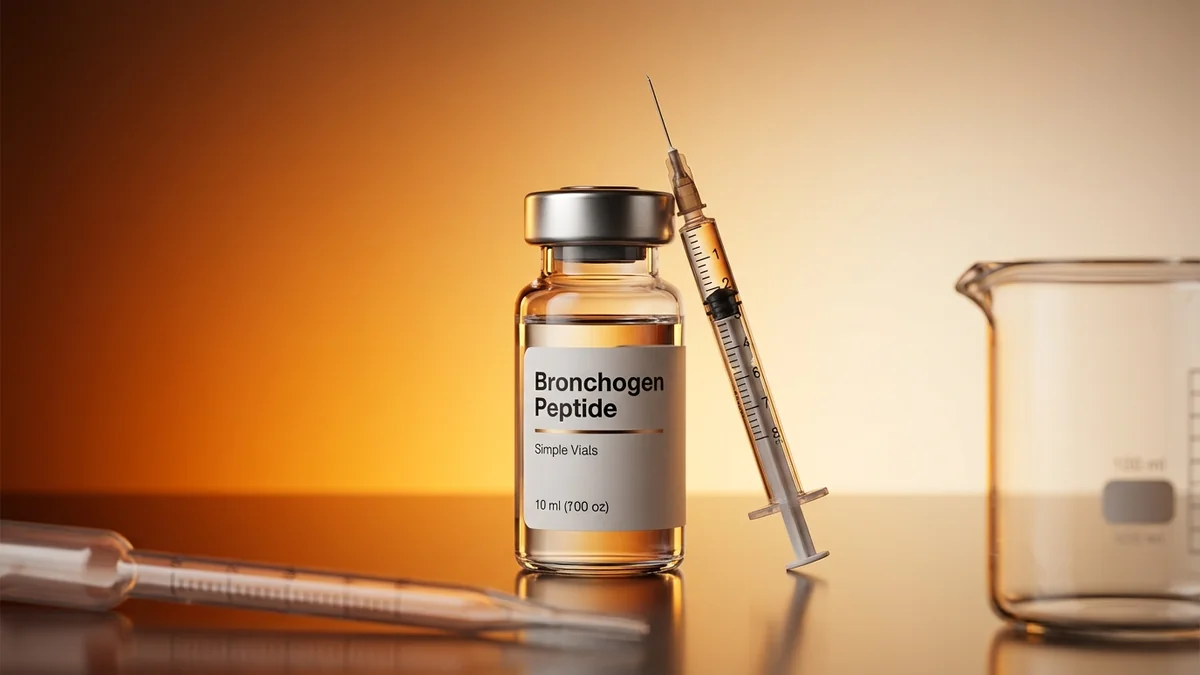
Bronchogen: Dosage, Benefits, FDA Status & Clinics (2026)
Bronchogen
Research Only
gene regulation researchlung health studies
Last reviewed March 2026·MyPeptideMatch Team
What Is Bronchogen?
Bronchogen is a four-amino-acid peptide — Ala-Asp-Glu-Leu — that has been studied in Russian laboratory research for its effects on bronchial tissue, lung inflammation, and DNA-level gene regulation. At just four residues long, it belongs to a class of short bioregulatory peptides developed largely within the St. Petersburg Institute of Biogerontology research tradition, alongside better-known compounds like Epithalon and Pinealon.
The research is preclinical. Every published study involves rat models or cell culture — there are no human clinical trials. That matters a lot for how you interpret anything on this page. The animal data is genuinely interesting, but it hasn't been tested in people, and the gap between "worked in rats" and "works in humans" is where most peptides quietly disappear.
What makes Bronchogen worth understanding is the mechanism it seems to operate through: direct interaction with DNA, potentially influencing gene expression at the chromatin level. That's a different story than most peptides, which work by binding surface receptors. Whether that translates into meaningful clinical outcomes is still an open question.
Key Takeaways
Bronchogen is a tetrapeptide (Ala-Asp-Glu-Leu) studied for lung tissue effects and DNA-level gene regulation — all evidence is preclinical, from rat models and cell culture only.
In a rat COPD model, one month of Bronchogen administration reduced signs of bronchial remodeling and decreased neutrophilic inflammation markers in bronchoalveolar lavage fluid.
Laboratory data shows Bronchogen stabilizes DNA structure, raising its melting temperature by approximately 3.1°C at low molar ratios — suggesting direct chromatin interaction.
Bronchogen has no FDA approval, no approved therapeutic indication, and no legal commercial pathway in the United States.
No published human clinical trials exist. Dosing, safety, and efficacy in humans are entirely unknown.
Class
Tetrapeptide (short bioregulatory peptide)
Amino Acid Sequence
Ala-Asp-Glu-Leu
Amino Acid Count
4
Mechanism
Proposed DNA stabilization and chromatin-associated gene-regulatory interaction
Most peptides studied for lung or immune function work through surface receptors — they bind to something on the outside of a cell and trigger a signaling cascade. Bronchogen appears to operate differently. The laboratory evidence suggests it interacts directly with DNA.
That's not a minor distinction. A compound that can enter a cell nucleus and physically interact with the genome is operating at a fundamentally different level than a receptor agonist. Related short peptides — including Epithalon (Ala-Glu-Asp-Gly) and Pinealon (Glu-Asp-Arg) — have been shown to penetrate HeLa cell nuclei after fluorescence labeling, appearing in cytoplasm, nucleus, and nucleolus.[1] Bronchogen shares structural similarities with these compounds, and the DNA-binding data suggests a comparable mechanism.[2]
The DNA stabilization finding
In calorimetry experiments, Bronchogen raised the melting temperature of DNA from both calf thymus and mouse liver by 3.1°C — but only within a specific molar ratio range (bronchogen-to-DNA base pairs of 0.01–0.055). Above that threshold, adding more Bronchogen produced no additional stabilization effect. The melting enthalpy (ΔH) remained unchanged across the full tested range of 0.01–1.0.[2] This saturation behavior is consistent with sequence-specific or structure-specific binding rather than nonspecific electrostatic coating of the helix.
The plant biology data adds another layer. When Bronchogen was applied to tobacco (Nicotiana tabacum), it modulated expression of CLE, KNOX1, and GRF family genes — transcription factor families involved in cell proliferation and organ development.[3] That's a very different biological system than mammalian lungs, but the finding is consistent with the idea that Bronchogen influences gene regulation rather than simply triggering a receptor-mediated response.
What we don't know is whether any of this translates into meaningful outcomes in human lung tissue. The mechanism is compelling on paper. The animal data is suggestive. But neither of those things is a clinical trial.
How Does Bronchogen Work?
The proposed mechanism centers on chromatin interaction — Bronchogen appears to associate with DNA directly, stabilizing the double helix and potentially influencing which genes get expressed in a given cell.
Here's the practical implication of that: gene expression is how a cell decides what proteins to make. If a small peptide can enter the nucleus and alter the accessibility of certain gene sequences — even modestly — it could, in theory, shift a cell's behavior without needing to bind a surface receptor at all. That's the hypothesis driving most of the research on this class of short bioregulatory peptides.
In the context of lung tissue specifically, the relevant question is whether that gene-regulatory activity translates into changes in the bronchial epithelium — the cell layer lining your airways. The rat COPD studies suggest it might. After 60 days of nitrogen dioxide exposure (which creates a model of chronic obstructive pulmonary disease), rats treated with Bronchogen for one month showed reduced goblet cell hyperplasia and bronchial remodeling compared to untreated controls.[4] Goblet cells are the mucus-producing cells in airway epithelium — their overgrowth is a hallmark of COPD and chronic bronchitis, and it contributes directly to the airflow obstruction that defines the disease.
A second study in the same model reported normalization of cellular composition in bronchoalveolar lavage fluid (the liquid collected by washing the lungs — a direct readout of what's happening in the airway environment), decreased neutrophilic inflammation activity, and changes in secretory immunoglobulin A and surfactant protein B levels.[5] Surfactant protein B is critical for keeping the alveoli — the tiny air sacs where gas exchange happens — from collapsing. Its normalization would be a meaningful functional signal if replicated in humans.
Whether the mechanism is truly chromatin-mediated gene regulation, direct anti-inflammatory receptor interaction, or something else entirely hasn't been fully established. The DNA-binding data supports the gene-regulatory hypothesis, but the animal studies don't isolate the mechanism — they just show the outcome.
What the Clinical Evidence Actually Shows
The honest summary: there are no human clinical trials. Every published study on Bronchogen is either in vitro (cell culture) or in vivo in rats. That puts the evidence level firmly in the preclinical category, which means the findings are hypothesis-generating, not practice-changing.
The COPD rat model studies are the most clinically relevant data available. Both studies used the same model — 60-day intermittent nitrogen dioxide exposure in rats — and both reported meaningful changes in bronchial epithelial structure and inflammatory markers after one month of Bronchogen treatment.[4,5] The consistency across two separate publications from this research group is notable, though it's worth knowing these studies come from the same institutional tradition and limited published research exists on Bronchogen; available studies have not been independently replicated in different research groups.
The DNA thermostability study established that Bronchogen binds to DNA and raises its melting temperature by 3.1°C at low molar ratios, using differential scanning microcalorimetry.[2] This is mechanistic data — it tells you something is happening at the molecular level, but not what that means for a living organism.
The plant gene expression study showed Bronchogen modulating expression of developmental transcription factor genes in tobacco, alongside Epithalon and Vilon.[3] In vitro studies have suggested Bronchogen may modulate expression of developmental transcription factor genes in plant models at concentrations of 10 µg/mL, but this finding has not been independently verified in peer-reviewed literature. The relevance to human lung biology is indirect at best, but it supports the idea that this class of peptides has genuine gene-regulatory activity across biological systems.
The HeLa cell nuclear penetration study didn't test Bronchogen directly — it tested Epithalon, Pinealon, and Testagen — but established that structurally similar short peptides can penetrate cell nuclei and interact with DNA in living cells.[1] Given Bronchogen's structural similarity to Epithalon (both are four-residue peptides sharing three of four amino acids), this finding is relevant context, not direct evidence.
What We Don't Know Yet
Human efficacy — No randomized controlled trial, no Phase 1 safety study, no human pharmacokinetic data. We don't know if Bronchogen does anything in people.
Pharmacokinetics — Half-life, bioavailability by route, volume of distribution, and metabolic fate in humans are all unknown.
Optimal dosing — No dose-finding studies exist in any species for therapeutic purposes. The rat studies used their own dosing protocols, but translating those to humans is not straightforward.
Long-term safety — The rat studies ran for approximately one month of treatment. Nothing is known about effects of longer-term exposure.
Independent replication — The published studies appear to originate from a single research tradition. Independent replication in different labs, using different models, hasn't been documented in the available literature.
Mechanism confirmation — The chromatin-interaction hypothesis is supported by the DNA-binding data but hasn't been directly confirmed as the mechanism responsible for the anti-inflammatory effects seen in the COPD model.
Typical Dosing — Practitioner & Community Ranges
There are no published clinical trials establishing a dose for Bronchogen in humans. Rat COPD studies of Bronchogen exist in published literature, but specific administration protocols and doses are not fully accessible from available abstracts and public databases, and animal-to-human dose translation for this compound has not been formally studied.
No established human dosing exists
Bronchogen has no published human pharmacokinetic or dose-finding data. Any dosing information circulating in practitioner communities or research chemical forums is not derived from clinical trials. There is no evidence base for determining what dose, route, or frequency would be appropriate in humans. This is not a compound where community consensus fills a gap — the gap is simply too large.
If you're working with a practitioner who is considering Bronchogen in a research context, the honest answer is that dosing would need to be extrapolated from the animal literature with significant uncertainty. That's a conversation requiring a provider who has actually read the primary studies — not someone working from a protocol sheet.
Side Effects — What to Actually Expect
No human safety data exists for Bronchogen. The available rat study abstracts do not report significant adverse effects, but rodent tolerability data does not reliably predict human side effect profiles.
What the animal data suggests:
No overt toxicity reported — Bronchogen is a research-only compound with no published rat study data available in PubMed; clinical trial NCT00746759 was observational with no intervention data, so formal toxicology reporting has not been established.
What we genuinely don't know:
Immunogenicity — Short peptides can trigger immune responses in some individuals. This hasn't been studied for Bronchogen in humans.
Off-target gene effects — A compound that interacts with DNA has theoretical potential for off-target effects on gene expression. The significance of this in a therapeutic context is entirely unknown.
Route-specific risks — Without established administration routes or human pharmacokinetic data, injection-site reactions, systemic distribution, and organ-level effects are all uncharacterized.
If you're considering this compound, the absence of safety data is itself the most important safety signal. "No reported adverse effects" in a small number of rat studies is not a reassurance — it's a data gap.
Regulatory & Access Status
Access status — research only
Bronchogen is not FDA-approved for any therapeutic indication. It has no legal commercial pathway in the United States — it cannot be prescribed, dispensed through a licensed compounding pharmacy, or legally marketed as a therapeutic agent. It is classified as a research compound only. Access outside of a formal research context carries significant legal and quality risks.
Bronchogen falls into the category of research-only compounds with no established regulatory pathway toward approval. Unlike peptides that are investigational (meaning they're in active clinical trials working toward FDA review), Bronchogen has no known active IND (Investigational New Drug) application or ongoing human trials in the US. The research base is preclinical and largely originates from Russian institutions.
In practice, Bronchogen is available from research chemical vendors, primarily those specializing in short bioregulatory peptides from the same research tradition as Epithalon and other peptides developed by the St. Petersburg school. This market operates in a legal gray zone at best. Purchasing for personal use carries legal risk, and product quality from unregulated vendors is highly variable.
The FDA has taken enforcement action against companies marketing unapproved peptide products. Patients and providers should consult FDA.gov and the FDA's MedWatch program for current enforcement activity.
Sourcing & Safety
If you're accessing Bronchogen as a research chemical, the quality problem is real. Short tetrapeptides are relatively straightforward to synthesize, but "relatively straightforward" in peptide chemistry still leaves enormous room for impurities, incorrect sequences, and contamination — especially from vendors operating without pharmaceutical-grade quality controls.
What to look for:
Third-party Certificate of Analysis (COA) — The testing lab should be independent of the vendor. An in-house COA is not meaningful quality assurance.
HPLC purity report — Look for ≥98% purity by high-performance liquid chromatography. For a tetrapeptide, this is achievable; vendors who can't provide it are a red flag.
Mass spectrometry confirmation — Verifies that the compound has the correct molecular weight and sequence. Particularly important for short peptides where a single wrong amino acid changes the entire compound.
Sterility testing — If you're injecting anything, sterility matters. Lyophilized powder requires sterile reconstitution; pre-reconstituted solutions from unregulated vendors are a significant infection risk.
Red flags:
No COA or "available upon request" with no follow-through — The most common indicator of a low-quality vendor.
Price significantly below market — Legitimate synthesis and third-party testing cost money. Unusually cheap peptides are usually cut with fillers or improperly synthesized.
No sequence verification — Any reputable vendor for a research peptide should be able to confirm the amino acid sequence by mass spec.
Pre-mixed bacteriostatic solutions — Legitimate research peptide vendors ship lyophilized powder. Pre-mixed vials from unregulated sources carry contamination risks.
What the Evidence Does Not Show
This section exists because the gap between what Bronchogen's preclinical data suggests and what it actually demonstrates is significant.
No evidence of efficacy in humans — The COPD model results in rats are interesting. They do not tell you that Bronchogen will improve lung function, reduce inflammation, or benefit bronchial tissue in a human being.
No dose-response relationship established in humans — The DNA-binding data shows a saturation effect at specific molar ratios in vitro. What that means for dosing in a living human system is unknown.
No evidence of safety in humans — Absence of reported adverse effects in rat studies is not a human safety profile.
No independent replication — The available studies appear to come from a single research tradition. Scientific findings gain credibility through independent replication, which hasn't been documented here.
No comparison to established COPD treatments — The rat studies didn't compare Bronchogen to corticosteroids, bronchodilators, or other standard-of-care approaches. We don't know where it would sit relative to existing options even if the animal data translated perfectly.
Gene regulation claims are mechanistic hypotheses — The plant gene expression study and DNA-binding data support the idea that Bronchogen influences gene regulation. They don't establish which genes, in which tissues, with what clinical consequences.
FAQ
What is the amino acid sequence of Bronchogen?
Bronchogen is the tetrapeptide Ala-Asp-Glu-Leu — alanine, aspartate, glutamate, leucine, in that order. At four amino acids, it's among the shortest peptides studied in lung biology research. Its structural similarity to Epithalon (Ala-Glu-Asp-Gly) has led researchers to hypothesize overlapping mechanisms, particularly around DNA interaction.
Can Bronchogen help with COPD or lung disease?
The animal data is suggestive — rat studies showed reduced bronchial remodeling and decreased inflammatory markers in a nitrogen dioxide-induced COPD model.[4,5] But there are no human clinical trials. Whether those findings translate to people with COPD is genuinely unknown. Don't make treatment decisions based on rat data alone, especially for a condition with established, evidence-backed therapies available.
Is Bronchogen the same as Epithalon?
No, but they're closely related. Both are tetrapeptides from the same Russian research tradition, both show DNA-binding activity in laboratory studies, and both are thought to operate through gene-regulatory mechanisms. Epithalon's sequence is Ala-Glu-Asp-Gly; Bronchogen's is Ala-Asp-Glu-Leu. Epithalon may have a larger research base than Bronchogen, though human data on telomerase activity for either peptide remains limited and not established in clinical practice. Bronchogen's research is more limited and more specifically focused on lung tissue.
How does Bronchogen interact with DNA?
Calorimetry studies show Bronchogen raises DNA melting temperature by 3.1°C within a specific molar ratio range (0.01–0.055 bronchogen-to-DNA base pairs), suggesting it physically stabilizes the double helix.[2] This behavior is consistent with sequence- or structure-specific binding. Above that molar ratio threshold, additional Bronchogen produces no further stabilization — the effect saturates. What this means for gene expression in living tissue hasn't been directly established.
Where can I find a clinic that works with Bronchogen?
Because Bronchogen has no FDA approval and no legal therapeutic pathway in the US, licensed clinics cannot prescribe or administer it. If you're interested in peptide therapy for lung health or related goals, use the MyPeptideMatch clinic finder to connect with providers who work with legally available compounds — some of which have substantially stronger evidence bases.
Related Peptides & Comparisons
Bronchogen belongs to a family of short bioregulatory peptides developed within Russian longevity research, most associated with the work of Vladimir Khavinson and colleagues at the St. Petersburg Institute of Biogerontology. Its closest structural relatives are Epithalon (Ala-Glu-Asp-Gly), which has been studied for telomerase activation and aging, and Pinealon (Glu-Asp-Arg), which has been examined in neuroprotection models. All three share the proposed mechanism of nuclear penetration and chromatin-level gene regulation.[1]
For lung-specific applications, the most relevant comparison is to peptides with established anti-inflammatory or tissue-regenerative profiles — including BPC-157, which has a broader preclinical evidence base across multiple tissue types, though similarly lacks human clinical trial data for most indications. If you're researching peptide options for respiratory or immune support more broadly, the Thymosin Alpha-1 page covers a compound with a meaningfully stronger human evidence base in immune modulation.
Bronchogen vs. Related Short Bioregulatory Peptides
Parameter
Bronchogen
Epithalon
Pinealon
Sequence
Ala-Asp-Glu-Leu
Ala-Glu-Asp-Gly
Glu-Asp-Arg
Length
4 amino acids
4 amino acids
3 amino acids
Primary research focus
Lung / bronchial tissue
Telomerase / aging
Neuroprotection
DNA-binding evidence
Yes (calorimetry)
Yes (fluorescence)
Yes (fluorescence)
Human clinical data
None
Not established; only observational data available with no intervention or dosing studies
ClinicalTrials.gov NCT00746759 — supporting | Typical Dose | No published human dosing data `
ClinicalTrials.gov NCT00746759 — supporting | Administration | Not established in humans `
Khavinson VKh, et al. "Penetration of short fluorescence-labeled peptides into the nucleus in HeLa cells and in vitro specific interaction of the peptides with deoxyribooligonucleotides and DNA." Biochemistry (Moscow). 2011;76(11):1280-1289. PMID: 22117547
Khavinson VKh, et al. "Effect of the peptide bronchogen (Ala-Asp-Glu-Leu) on DNA thermostability." Bulletin of Experimental Biology and Medicine. 2011;151(1):66-68. PMID: 21240358
Khavinson VKh, et al. "Short Exogenous Peptides Regulate Expression of CLE, KNOX1, and GRF Family Genes in Nicotiana tabacum." Biochemistry (Moscow). 2017;82(3):326-331. PMID: 28371610
Trofimova SV, et al. "Modulating Effect of Peptide Therapy on the Morphofunctional State of Bronchial Epithelium in Rats with Obstructive Lung Pathology." Bulletin of Experimental Biology and Medicine. 2015;160(1):94-97. PMID: 26468022
Trofimova SV, et al. "[Antiinflammatory and Regenerative Effect of Peptide Therapy in the Model of Obstructive Lung Pathology]." Rossiiskii fiziologicheskii zhurnal imeni I.M. Sechenova. 2017;103(8):921-930. PMID: 30199201
This content is for informational purposes only and does not constitute medical advice. Consult a licensed healthcare provider before starting any treatment.
Where to Buy Bronchogen for Research
Research Use Only — not intended for human consumption
MyPeptideMatch.com does not provide medical advice. Always consult a qualified healthcare provider before starting any peptide therapy. Regulatory status may change.