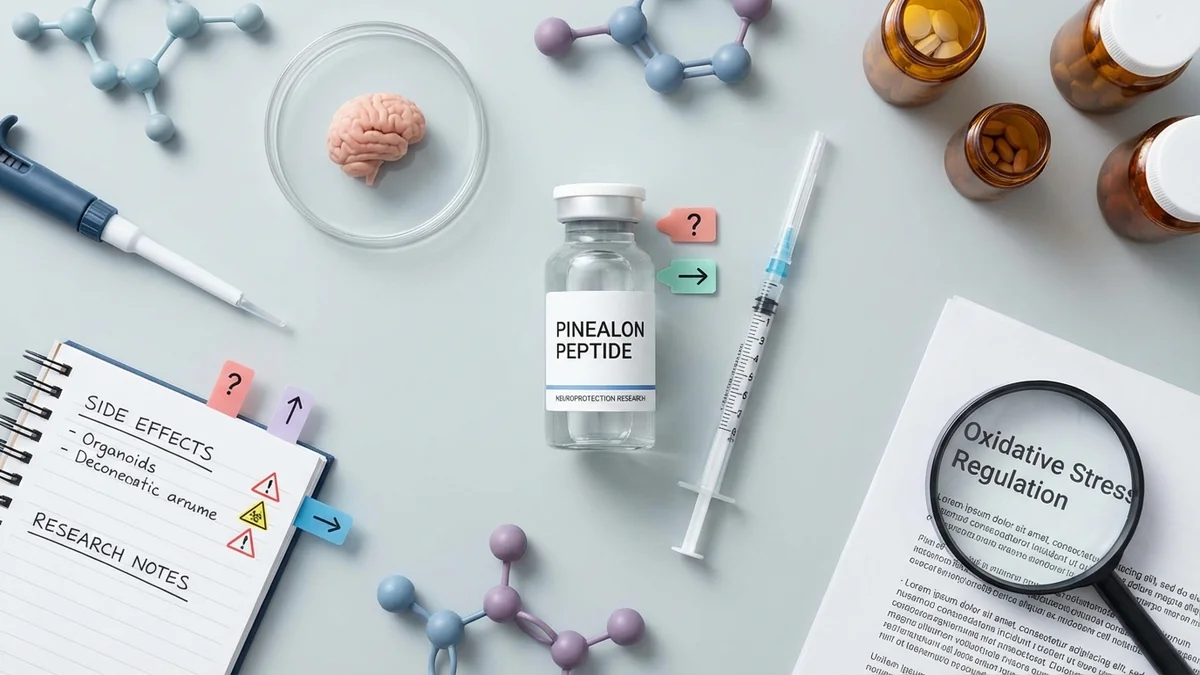
Pinealon is a three-amino-acid peptide: glutamic acid, aspartic acid and arginine, written Glu-Asp-Arg or EDR. It belongs to the "peptide bioregulator" family developed by Vladimir Khavinson's group in St. Petersburg, which lists it as a neuroprotector.[1][2]
The name points to the pineal gland, and many sellers pitch it for sleep and melatonin. The research points somewhere else. Almost every Pinealon study looks at neurons, brain injury models and memory in animals, and the one study we found that tested it on pineal cells came back negative.
The evidence is a set of cell and rodent studies plus a few small Russian human reports, nearly all from Khavinson's institute and its collaborators. It is consistent, and some of it is recent, but it has not been replicated by an independent group and has never been tested in a placebo-controlled trial.
- Pinealon is the synthetic tripeptide Glu-Asp-Arg (EDR), developed by Khavinson's group as a brain-targeted "bioregulator."
- Cell and rodent studies show reduced oxidative stress in neurons, protection of dendritic spines in Alzheimer's models, and better maze learning in old rats.
- Human data is limited to small Russian studies of "biological age" with no placebo arm described in their abstracts. No trial appears on ClinicalTrials.gov (searched October 2026).
- The only published human dose is oral: 100 µg twice daily for two weeks. There is no established injectable dose, half-life or nasal spray data.
- Despite the name, there is no published evidence that Pinealon affects sleep, melatonin or the pineal gland.
| Common Name | Pinealon |
| Sequence | Glu-Asp-Arg (EDR) |
| Formula / Molecular Weight | C15H26N6O8 / about 418 Da |
| Class | Synthetic short peptide ("peptide bioregulator") |
| Developed by | Khavinson group, St. Petersburg Institute of Bioregulation and Gerontology |
| Primary Research Areas | Neuron survival under oxidative stress, Alzheimer's disease models, learning in aged rats |
| Human Trials | Small Russian open studies; none registered on ClinicalTrials.gov |
| FDA Status | Not approved for any indication |
| Forms Sold | 10–20 mg lyophilized "research" vials; oral capsules; nasal sprays |
| Typical Dose | No established dose; one human study used 100 µg orally twice daily |
What Is Pinealon?
Pinealon is one of several very short synthetic peptides that Khavinson's group designed and tested from the 1990s onward. The group's systematic review lists EDR among its neuroprotective peptides and notes that it is also a component of Cortexin, a Russian brain-extract drug.[1] Its transport review assigns each short peptide a target organ; for EDR the entry is "neuroprotector."[2]
People searching for Pinealon mostly want two things: what it does, and how much to take. The honest answers are that it has a coherent body of lab and animal research behind it, and that nobody has worked out a human dose.
How Does Pinealon Work?
Khavinson's group proposes that peptides of two to seven amino acids can pass through cell and nuclear membranes and bind DNA or histone proteins, changing which genes are switched on.[1] For EDR, the group's modeling suggests it is a strong fit for the LAT1 and PEPT1 transporters that move small peptides into cells, which would be one way it gets in.[6] These are computer-modeling results, not measurements in living tissue.
What has been measured in cells:
- Oxidative stress. In a 2011 study, Pinealon reduced the build-up of reactive oxygen species in a dose-dependent way in rat cerebellar neurons, immune cells (neutrophils) and a nerve-like cell line (PC12), and reduced necrotic cell death. It also shifted the cell cycle at higher concentrations, which the authors took as a sign that it acts on the genome directly.[3]
- A conflicting result. An earlier experiment from the same institute found that Pinealon had no direct antioxidant activity and actually raised steady-state reactive oxygen species inside neurons, while still lowering the share of dead cells.[4] So "antioxidant" is a simplification.
- Serotonin. EDR and a related peptide (KED) increased serotonin expression in aging cultures of brain cortex cells. A link to the gene for tryptophan hydroxylase, the enzyme that makes serotonin, came from docking models.[5]
Pinealon is not the pineal peptide
In a culture of rat pineal gland tissue, Pinealon did not increase the proliferation marker Ki-67. Two other peptides did. Only Epitalon (Ala-Glu-Asp-Gly) increased the secretory marker the authors measured.[12] If you want the Khavinson peptide studied for the pineal gland and melatonin, that is Epitalon, not Pinealon.
What the Clinical Evidence Actually Shows
The evidence falls into three tiers, and the strength drops sharply between them.
Cell studies. In mouse hippocampal neurons exposed to amyloid (a lab model of Alzheimer's disease), EDR at 200 ng/mL increased the number of mature "mushroom" dendritic spines by 71%, back to normal levels.[7] In 2024, the group tested EDR on neurons made from the skin cells of elderly donors. It increased dendrite branching and reduced oxidative DNA damage, but had no effect on mitochondrial or lysosomal activity or on the aging marker p16.[8]
Animal studies. These are the most useful part of the record:
- In rats whose mothers were fed excess methionine during pregnancy (raising homocysteine, which damages the developing brain), giving Pinealon to the mothers improved the offspring's learning and spatial orientation and made their cerebellar neurons more resistant to oxidative stress.[9]
- In 5xFAD mice, a genetic Alzheimer's model, EDR injected at 400 µg/kg daily for two months increased dendritic spine density in the hippocampus by about 11%. Its effect on long-term potentiation, the electrical basis of memory, was a trend that did not reach statistical significance, and in female mice it did not restore the mature spines that had been lost.[10]
- In young and old rats exposed to acute hypoxia, Pinealon improved learning in the Morris water maze more than Cortexin did.[11]
Human studies. We found three Russian-language studies in PubMed, all published in Advances in Gerontology:
- Train crew workers took one 100 µg Pinealon capsule twice a day for two weeks. The authors reported better "biological age" and adaptation scores. The abstract gives no group sizes and does not describe a control group.[13]
- 32 people aged 41 to 83 with several chronic illnesses and organic brain syndrome took Pinealon or Vesugen. Both were reported to improve biological age measures, Vesugen more clearly than Pinealon. The same study found a pro-oxidant effect and a fall in CD34+ blood stem cells.[14]
- In 110 people comparing several "geroprotective" methods, the largest change in biological age markers came from combining Vesugen and Pinealon.[15]
"Biological age" in these studies is a composite score built from physiological tests, not a clinical outcome like memory, dementia or lifespan. None of the abstracts describes placebo control or blinding.
What the Evidence Does Not Show
- Better memory or focus in healthy people. No human study has measured cognitive performance with standard tests against placebo.
- Effects on sleep or melatonin. No study we found measured either. The evening-dosing advice online rests on the name, not on data.
- Benefit in Alzheimer's or other dementia. The Alzheimer's findings are in cell cultures and mice. No patient trial exists.
- Pharmacokinetics. There is no published half-life, oral bioavailability or brain-penetration data in humans.
- Independent replication. Every study cited here includes authors from Khavinson's institute or its close collaborators.
Typical Dosing — What the Research Has Used
No established human dose
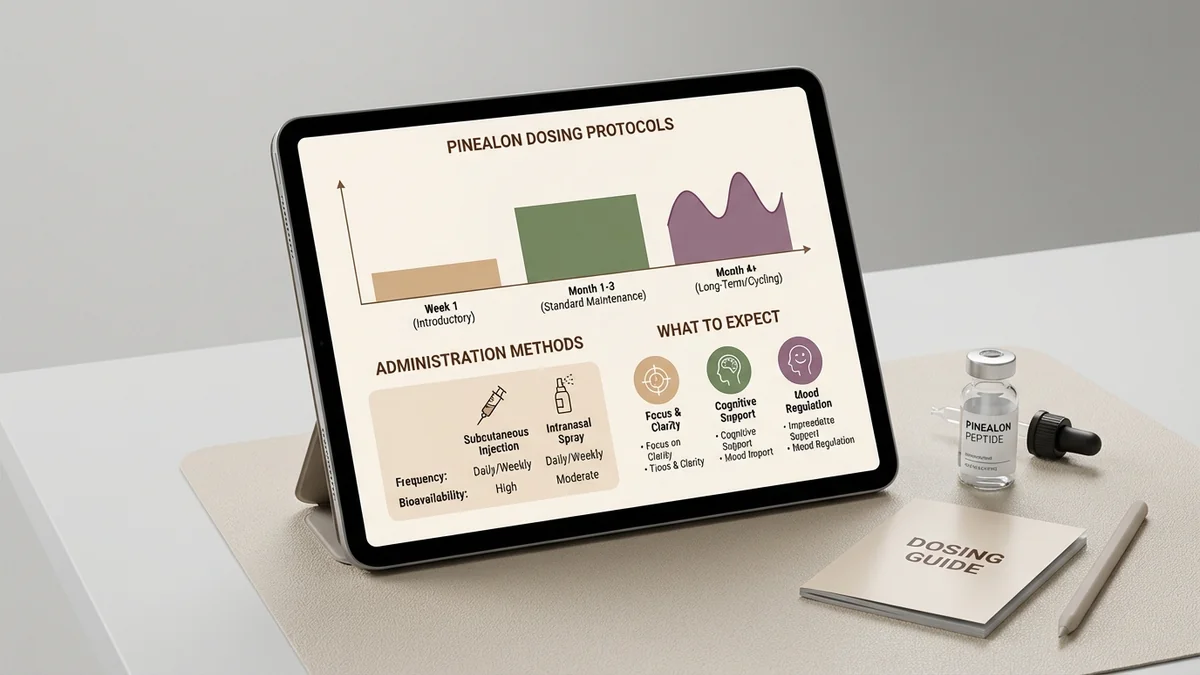
No published trial has established a safe or effective dose of Pinealon for any route. The figures below describe what studies used and what circulates online. They are not dosing guidance.
The research has used three very different kinds of dose:
- Cell cultures: 200 ng/mL of EDR in the dish.[7]
- Mice: 400 µg/kg by intraperitoneal injection once a day for two months.[10]
- Humans: one 100 µg oral capsule twice a day (200 µg a day) for two weeks.[13] The group's 2023 review says EDR is given orally to older people as part of treatment for brain disorders and to athletes for endurance, but it cites no controlled trial for either use.[6]
Searches for a Pinealon dosage chart, cycle or protocol are looking for something the research hasn't produced. Here is what can be said about the common questions:
- Community-reported amounts. Online protocols for injectable vials most often quote around 200 µg a day, typically in 10-day to several-week courses with weeks off in between. These come from online protocols, not from trials. Our Pinealon dosing protocol page covers reconstitution math for the 20 mg vial, which helps with measuring accurately but is not evidence that a dose works.
- 10 mg vs 20 mg vials. Same peptide, different fill. Vial size changes how much water you add and how many doses a vial holds, not what dose is appropriate.
- Oral vs injection. The only human data is oral. Nobody has compared oral and injected Pinealon, and whether a tripeptide survives digestion intact is unknown. Khavinson's group argues that small peptide transporters in the gut could carry it in, based on modeling.[2]
- Nasal spray. No published study.
- Morning or night, and cycle length. Not studied. The only human course in PubMed lasted two weeks.
- Bodybuilding. No study has looked at muscle, strength or body composition.
Side Effects — What to Actually Expect
No study has collected Pinealon side effects systematically, so there is no evidence-based list of common side effects.
The one safety signal in the literature is worth knowing. In the 32-patient study, the authors reported pro-oxidant activity on chemiluminescence testing and a decrease in CD34+ cells (early blood-forming stem cells) in the blood, which they described as significant inhibition of blood cell production.[14] They still recommended the peptides for geriatric use. A single small study can't settle whether this is real or important, but it is the opposite of "no side effects."
Beyond that:
- Injection risks apply to any injected research peptide: redness, pain or swelling at the site, and infection if the product or technique isn't sterile.
- Product quality is the larger practical risk. Research vials are not made to drug manufacturing standards.
- Long-term effects are unknown. The proposed mechanism is gene regulation, and nobody has followed users for years.
If you have a neurological condition, a blood disorder, cancer, or are pregnant or breastfeeding, the lack of safety data is a strong reason to talk to a physician first.
Regulatory & Access Status
Access status as of October 2026
Pinealon is not FDA-approved for any indication and cannot be prescribed as an approved drug. Eight clinics on our directory list Pinealon among the peptides they offer.
In the US, Pinealon is sold three ways: injectable vials labeled "research use only," oral capsules sold as supplements, and nasal sprays. None of these involves FDA review of safety or effectiveness. A clinic that offers Pinealon is using it outside any approved indication, so ask what product they use and where it comes from.
Sourcing & Safety
The checks that matter more than the brand name:
- An independent certificate of analysis (COA) from a named third-party lab, dated, for your batch.
- HPLC purity of at least 98% and mass spectrometry confirming Glu-Asp-Arg at about 418 Da.
- Sterility and endotoxin testing for anything injected.
Red flags: no third-party COA, claims that Pinealon "restores the pineal gland" or treats dementia, and references to human trials that can't be found in PubMed.
What Makes Pinealon Different
Most peptides discussed for the brain, like Semax and Selank, are fragments or analogs of natural signaling peptides, developed as nasal drugs in Russia and pitched for short-term effects on focus or anxiety. Pinealon is pitched as a slow "regulator" taken in courses, and at three amino acids it is shorter than either. It is also one of the few bioregulators with a recent, peer-reviewed mouse study in an Alzheimer's model, though that study's results were modest.[10]
Pinealon vs. Other Peptides Discussed for the Brain
| Parameter | Pinealon | Epitalon | Semax |
|---|---|---|---|
| Sequence | Glu-Asp-Arg (3 amino acids) | Ala-Glu-Asp-Gly (4 amino acids) | 7 amino acids (ACTH(4-10) analog) |
| Proposed role | Neuroprotection, gene regulation in neurons | Pineal gland function, aging | Focus, recovery after stroke |
| Main evidence | Cell and rodent studies, small Russian human reports | Cell and animal studies, limited human data | Russian clinical studies, mainly in stroke |
| Effect on pineal cells | None found in culture | Increased pineal cell activity in culture | Not studied |
| FDA status | Not approved | Not approved | Not approved |
FAQ
What is Pinealon peptide?
Pinealon is a synthetic tripeptide, glutamic acid-aspartic acid-arginine (Glu-Asp-Arg, or EDR), developed by Vladimir Khavinson's group at the St. Petersburg Institute of Bioregulation and Gerontology. The group classes it as a 'neuroprotector'. It is sold as a research peptide and in oral capsules, and it is not an approved drug in the US.
What are the benefits of Pinealon?
In cell and animal studies, Pinealon reduced oxidative stress and cell death in neurons, protected dendritic spines in Alzheimer's disease models, and improved maze learning in rats. Small Russian human studies reported better 'biological age' scores. None of these benefits has been confirmed in a placebo-controlled trial, and almost all of the work comes from one research network.
What is the dosage of Pinealon per day?
No dose has been established by a clinical trial. The only human dose we found in PubMed is an oral one: a 100 µg capsule twice a day for two weeks, in a Russian study of train crews. Community-reported amounts for injectable vials are often around 200 µg a day. That figure comes from online protocols, not from research.
Is Pinealon taken orally, by injection or as a nasal spray?
All three forms are sold. The published human studies used oral capsules. Animal studies injected it. We found no published study of Pinealon nasal spray, and no human pharmacokinetic study for any route, so its bioavailability and half-life are unknown.
When is the best time to take Pinealon, and does it help sleep?
No study has compared morning and evening dosing or measured Pinealon's effect on sleep or melatonin. Evening timing is often recommended online because of the 'pineal' name, but in the one pineal-gland cell study, Pinealon did not stimulate pineal cells; a different peptide, Epitalon, did.
What are the side effects of Pinealon? Is it safe?
There is no systematic human safety data. One small Russian study in 32 older patients reported a pro-oxidant effect and a fall in CD34+ blood stem cell markers, which the authors read as some suppression of blood cell production. Injected research vials also carry the usual risks of site reactions, contamination and uncertain purity.
Is Pinealon FDA approved?
No. Pinealon has no FDA approval for any use. Injectable vials are sold labeled 'for research use only', and oral products are sold as supplements, which the FDA does not review before sale.
Related Peptides & Comparisons
If you're weighing Pinealon for brain health, compare it with Semax, Selank and Cerebrolysin, a brain-derived peptide mixture with a larger clinical trial record. For pineal and aging questions, Epitalon is the better-matched compound. From the same bioregulator family, see Vilon and Cartalax. For the wider set of options, see our guides to cognitive enhancement and anti-aging and longevity.
References
- Khavinson VK, Popovich IG, Linkova NS, et al. "Peptide Regulation of Gene Expression: A Systematic Review." Molecules. 2021;26(22):7053. PMID: 34834147
- Khavinson V, Linkova N, Kozhevnikova E, et al. "Transport of Biologically Active Ultrashort Peptides Using POT and LAT Carriers." Int J Mol Sci. 2022;23(14):7733. PMID: 35887081
- Khavinson V, Ribakova Y, Kulebiakin K, et al. "Pinealon increases cell viability by suppression of free radical levels and activating proliferative processes." Rejuvenation Res. 2011;14(5):535-541. PMID: 21978084
- Kozina LS, Arutiunian AV, Stvolinskiĭ SL, et al. "Biological activity of regulatory peptides in model experiments in vitro." Adv Gerontol. 2008;21(1):68-73. PMID: 18546826
- Khavinson VKh, Lin'kova NS, Tarnovskaya SI, et al. "Short peptides stimulate serotonin expression in cells of brain cortex." Bull Exp Biol Med. 2014;157(1):77-80. PMID: 24909721
- Khavinson VK, Linkova NS, Rudskoy AI, et al. "Feasibility of Transport of 26 Biologically Active Ultrashort Peptides via LAT and PEPT Family Transporters." Biomolecules. 2023;13(3):552. PMID: 36979488
- Kraskovskaya NA, Kukanova EO, Lin'kova NS, et al. "Tripeptides Restore the Number of Neuronal Spines under Conditions of In Vitro Modeled Alzheimer's Disease." Bull Exp Biol Med. 2017;163(4):550-553. PMID: 28853087
- Kraskovskaya N, Linkova N, Sakhenberg E, et al. "Short Peptides Protect Fibroblast-Derived Induced Neurons from Age-Related Changes." Int J Mol Sci. 2024;25(21):11363. PMID: 39518916
- Arutjunyan A, Kozina L, Stvolinskiy S, et al. "Pinealon protects the rat offspring from prenatal hyperhomocysteinemia." Int J Clin Exp Med. 2012;5(2):179-185. PMID: 22567179
- Khavinson V, Ilina A, Kraskovskaya N, et al. "Neuroprotective Effects of Tripeptides-Epigenetic Regulators in Mouse Model of Alzheimer's Disease." Pharmaceuticals (Basel). 2021;14(6):515. PMID: 34071923
- Mendzheritski AM, Karantysh GV, Abramchuk VA, et al. "Effect of peptide geroprotectors on the navigation system learning and caspase-3 in brain structures in rats of different age." Adv Gerontol. 2013;26(2):252-257. PMID: 28976148
- Khavinson VKh, Linkova NS, Chalisova NI, et al. "Effect of short peptides on expression of signaling molecules in organotypic pineal cell culture." Bull Exp Biol Med. 2011;152(1):138-141. PMID: 22803060
- Nazimko VA, Morgul' EV, Petrova OA, et al. "Analysis of some parameters of biological age and adaptation possibilities of workers of locomotive brigades." Adv Gerontol. 2012;25(1):57-62. PMID: 22708445
- Meshchaninov VN, Tkachenko EL, Zharkov SV, et al. "Effect of synthetic peptides on aging of patients with chronic polymorbidity and organic brain syndrome of the central nervous system in remission." Adv Gerontol. 2015;28(1):62-67. PMID: 26390612
- Myakotnykh VS, Torgashov MN, Egorin KV, et al. "Comparative analysis of different methods of geroprotective." Adv Gerontol. 2016;29(4):594-601. PMID: 28539017
This content is for informational purposes only and does not constitute medical advice. Consult a licensed healthcare provider before starting any treatment.