What Is Cerebrolysin?
Cerebrolysin is not a single peptide. It is a mixture of low-molecular-weight peptides and amino acids made by controlled digestion of proteins from pig brain.[1][2] It is given as an intravenous infusion, usually daily for 10 to 21 days. Unlike most research peptides, it is a licensed medicine in some countries.[1]
It is widely used for acute ischaemic stroke in Russia, Eastern Europe, China, and other Asian and post-Soviet countries, according to the 2023 Cochrane review.[2] It is not approved by the FDA. Of the 43 Cerebrolysin studies registered on ClinicalTrials.gov (searched October 2026), none lists a US site.
Unlike most peptides on our site, Cerebrolysin has been tested in thousands of people, in randomized trials for stroke, traumatic brain injury and dementia. The results are mixed, and who ran the trials matters to how they read. In the US, it reaches people mostly as lyophilized "research" vials, usually 60 mg and often sold under the product code CBL60. That is a different product from the one in the trials.
- Cerebrolysin is a mixture of peptides and amino acids from digested pig brain protein, given by IV infusion in clinical use. It is licensed in some countries but not by the FDA.
- The 2023 Cochrane review (7 trials, 1,773 people) found it probably does not reduce deaths after ischaemic stroke, and may increase non-fatal serious adverse events.
- Trial-investigator meta-analyses report better early neurological scores after stroke and better combined outcomes after moderate to severe brain injury.
- Dementia evidence is small and low quality: Cochrane rated the vascular dementia data "very low quality."
- Trials dosed it in mL by IV, usually 30 mL a day. No trial used subcutaneous injection or the 60 mg powder vials sold online.
| Common Name | Cerebrolysin |
| What It Is | Mixture of low-molecular-weight peptides and amino acids from porcine (pig) brain protein |
| Class | Biological peptide preparation, marketed as neurotrophic |
| Route in Trials | Intravenous infusion (a few registered trials used intramuscular injection) |
| Doses in Trials | 10–60 mL per day of the licensed solution, mostly 30 mL a day for 10–21 days |
| Studied For | Acute ischaemic stroke, stroke rehabilitation, traumatic brain injury, Alzheimer's and vascular dementia |
| Human Trials | Dozens of randomized trials; two Cochrane reviews |
| FDA Status | Not approved |
| Where It Is Used | Russia, Eastern Europe, China, other Asian and post-Soviet countries |
| Forms Sold in the US | Lyophilized "research" vials, often 60 mg |
| Also Sold As | CBL60 (vendor product code for the 60 mg research vial) |
How Does Cerebrolysin Work?
Nobody knows exactly, partly because it is a mixture rather than one molecule. The usual explanation is that its peptides act like the brain's own growth factors (neurotrophic factors such as BDNF and NGF), protecting nerve cells after injury and supporting repair.
The best direct look at what is in it comes from a 2015 Belgian lab analysis of Cerebrolysin bought online. Using mass spectrometry, the researchers identified 638 different peptides, mostly fragments of tubulin, actin and myelin basic protein. They found no fragments of the known neurotrophic factors GDNF, NGF, BDNF or CNTF.[1] Their conclusion was that any effect must come from other, still unidentified peptides.[1]
So the "neurotrophic" label describes the activity researchers propose, not neurotrophic factors that have been found in the product. That distinction matters when vendors describe it as "containing BDNF."
What the Clinical Evidence Actually Shows
The trial base is much larger than for most peptides, but much of it was designed, analysed or pooled by the same group of investigators, often with manufacturer support. Independent reviews tend to read the same data less favourably.
Acute ischaemic stroke
The Cochrane view. The 2023 Cochrane review included seven randomized trials with 1,773 participants (one used a similar product, Cortexin). Cerebrolysin probably made little to no difference to death from any cause (risk ratio 0.96, moderate certainty). None of the trials reported another of Cochrane's main outcomes, death or dependence at the end of follow-up. The reviewers found risk of bias unclear or high across most trials, and noted that the manufacturer supported three of the multicentre studies.[2]
The largest single trial. CASTA randomized 1,070 people in Asia to 30 mL of Cerebrolysin or saline daily for 10 days, starting within 12 hours of stroke. Its main endpoint showed no difference. A post hoc look at the most severe strokes showed a favourable trend, which the authors said needed a new trial to confirm.[3]
Rehabilitation trials. CARS gave 30 mL a day for 21 days, starting 24 to 72 hours after stroke, alongside a standard rehab program. Arm function at day 90 was clearly better than placebo. The authors called the study exploratory and relatively small.[4]
Meta-analyses. A meta-analysis of nine trials (1,879 people) by investigators from those trials found better early neurological scores (NIHSS) with Cerebrolysin, with a number needed to treat of 7.7: roughly one extra patient with a clinically relevant early improvement for every eight treated.[5] A 2025 meta-analysis of 14 trials (2,884 people) by a separate team found a 1.39-point greater NIHSS improvement, but no significant difference in the share of patients who ended up functionally independent.[6]
Guidelines. A 2021 European Academy of Neurology guideline recommends Cerebrolysin (30 mL a day IV for at least 10 days) for early motor rehabilitation after ischaemic stroke.[7] Several of its authors are also authors of the Cerebrolysin trials and meta-analyses above.[5][7]
The two camps differ mainly in which outcome they weight. Early neurological scores tend to favour Cerebrolysin; death and long-term independence do not show a clear benefit.
Traumatic brain injury
The CAPTAIN trials gave 50 mL a day for 10 days, then two further 10-day courses of 10 mL a day, on top of usual care, to people with moderate to severe injury. CAPTAIN I enrolled 46 people and narrowly missed its primary endpoint in the main analysis.[9] CAPTAIN II enrolled 142 at a single centre and found a small-to-medium benefit on a combined set of 13 outcome scales at day 90.[10] Pooled, the 185 patients showed a small-to-medium effect at days 30 and 90.[11]
An independent 2023 meta-analysis of ten studies (8,749 patients, including retrospective studies) found improved Glasgow Coma and Glasgow Outcome scores, but no effect on death or length of hospital stay.[12] Most of those patients came from observational studies, not randomized trials.
Dementia
Vascular dementia. The 2019 Cochrane review found six trials with 597 people. Cerebrolysin improved cognition (standardized mean difference 0.36) and global function, but the evidence was rated very low quality, the trials had high risk of bias, and every trial that reported funding was industry-supported.[13]
Alzheimer's disease. A meta-analysis of six trials using 30 mL a day found better cognition at 4 weeks, but not at 6 months, and better global clinical change at both times.[14] In a 24-week trial comparing 10, 30 and 60 mL, only 10 mL improved cognitive scores; the higher doses improved global ratings but not cognition.[15]
What the Evidence Does Not Show
- Fewer deaths after stroke. Cochrane found no mortality benefit.[2]
- Long-term independence after stroke. The 2025 meta-analysis found no significant gain in functional independence.[6]
- Anything about the online powders. Every trial used the licensed IV solution. None tested lyophilized vials, subcutaneous injection, or home use.
- Benefit in healthy people. No trial tested it as a cognitive enhancer in people without brain injury or dementia.
- Independent confirmation of the brain injury results. The randomized TBI data come from one trial series and its own pooled analysis.[11]
Typical Dosing — What the Research Has Used
Hospital doses, not home doses
Every dose below was given by intravenous infusion under medical supervision, using the licensed solution. None of it is guidance for self-injection, and none of it converts cleanly to milligrams of a research powder.
| Condition | What trials gave |
|---|---|
| Acute stroke | 30 mL a day IV for 10 days[3] |
| Stroke rehabilitation | 30 mL a day IV for 21 days, with rehab[4]; 30–50 mL a day for 10–21 days across nine trials[5] |
| Traumatic brain injury | 50 mL a day for 10 days, then two 10-day courses of 10 mL a day[9][10] |
| Alzheimer's disease | 10, 30 or 60 mL IV, 5 days a week for 4 weeks, then twice a week for 8 weeks[15] |
Dosage in mg. Trials report volume (mL) of the licensed solution, not milligrams. One registered trial on ClinicalTrials.gov (NCT04830943) describes that solution as containing 215.2 mg of Cerebrolysin per mL. On that figure, a 60 mg vial would equal about 0.3 mL if it were the same material, while trial doses were 10 to 50 mL a day. Nobody has shown that research powders are the same material, so this arithmetic shows the scale gap rather than giving a conversion.
Subcutaneous use. We found no human trial of subcutaneous Cerebrolysin in PubMed, and none of the 43 studies on ClinicalTrials.gov used it. Intramuscular injection appears in a few registered trials (for example, post-COVID loss of smell and Bell's palsy); everything else was intravenous.
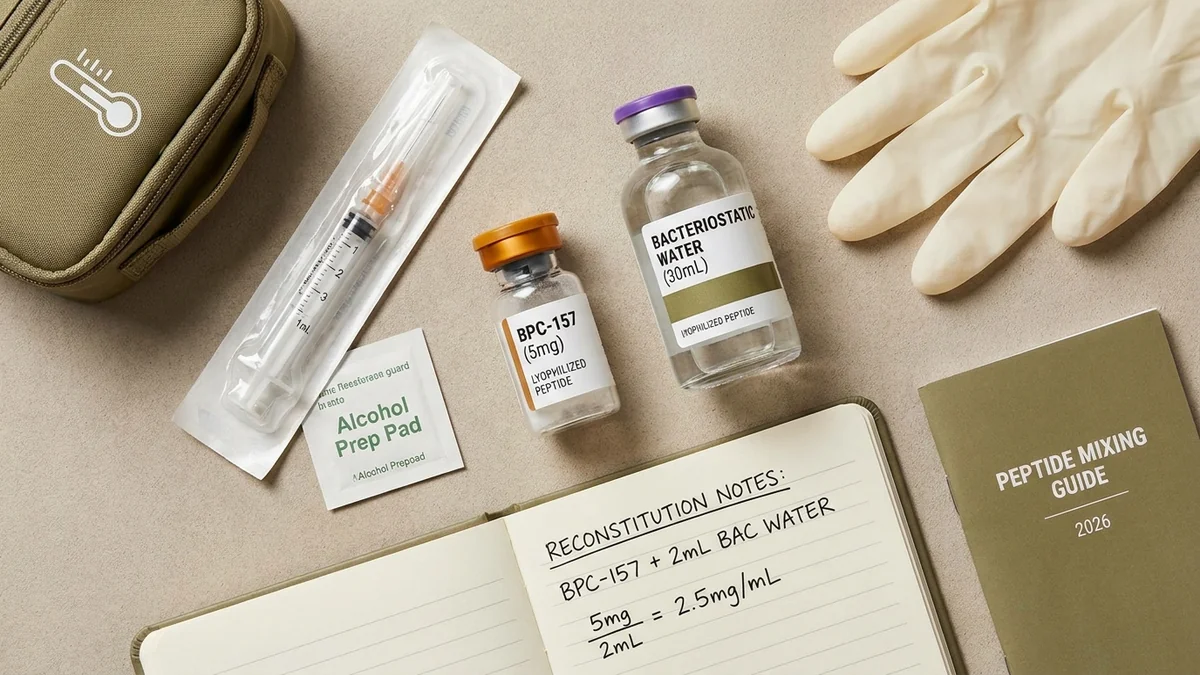
Reconstitution. Our Cerebrolysin 60 mg dosing protocol page covers the reconstitution and measuring math for the research vial. It helps with measuring accurately; it is not evidence that the dose works or matches a trial.
More is not clearly better. In the Alzheimer's dose trial, 10 mL beat 30 and 60 mL on cognition.[15] In the Cochrane stroke review, the rise in non-fatal serious adverse events was most visible with 30 mL for 10 days.[2]
Side Effects
In most individual trials, overall side effect rates looked similar to placebo.[4][10][15] A safety meta-analysis of 12 stroke trials (2,202 people), written partly by trial investigators, found no significant differences from placebo.[8]
Cochrane's analysis found one signal worth knowing. Across three trials with 1,335 people, Cerebrolysin did not change the total number of serious adverse events, but people on it had about 2.4 times the rate of non-fatal serious adverse events (risk ratio 2.39, moderate certainty). In the subgroup given 30 mL a day for 10 days, the risk ratio was 2.87.[2] The review does not break down which events those were.
For the research vials sold in the US, the bigger unknowns are product identity, sterility and contamination. Cerebrolysin comes from animal tissue, and nobody independently verifies what a research vial contains. Infusion or injection also carries the usual risks of site reactions and infection.
Regulatory & Access Status
Access status as of October 2026
Cerebrolysin is not FDA-approved for any indication. Four clinics on our directory currently list Cerebrolysin among the treatments they offer.
Outside the US, Cerebrolysin is used as a licensed medicine in a number of countries, especially in Eastern Europe and Asia.[2] We have not listed specific national approvals because we could not confirm each one from a regulator source.
In the US, what is sold online as Cerebrolysin is usually a lyophilized powder labeled for research use. That is not the licensed IV solution used in trials, and the label means no regulator has checked its contents.
Sourcing & Safety
If you or a clinician are considering Cerebrolysin:
- Ask which product it is. The licensed solution and a research powder are different products, and only the solution has trial data.
- Ask for a batch certificate of analysis. For a mixture of hundreds of peptides, purity percentages mean less than they do for a single peptide. Sterility and endotoxin testing matter more for anything injected.
- Be wary of "contains BDNF" claims. The one published composition analysis found no fragments of known neurotrophic factors.[1]
Treat as red flags: claims of FDA approval, promises of cognitive enhancement in healthy people, and protocols that cite trial doses in mg.
What Makes Cerebrolysin Different
Most nootropic peptides on our site, like Semax, Selank and Dihexa, are single defined molecules with a short sequence. Cerebrolysin is a biological extract with hundreds of components and much more human trial data, mostly in hospital patients after stroke or brain injury.
Cerebrolysin vs. Other Peptides Discussed for the Brain
| Parameter | Cerebrolysin | Semax | Dihexa |
|---|---|---|---|
| What it is | Mixture of hundreds of pig-brain peptides | Single synthetic 7-amino-acid peptide | Single synthetic small peptide derivative |
| Route in research | IV infusion | Intranasal | Oral or injected in animal studies |
| Main human evidence | Dozens of RCTs in stroke, TBI, dementia | Mostly Russian clinical studies | No published human trials |
| Independent systematic review | Two Cochrane reviews | None | None |
| FDA status | Not approved | Not approved | Not approved |
FAQ
What is Cerebrolysin?
Cerebrolysin is a mixture of small peptides and amino acids made by breaking down proteins from pig brain. It is given by intravenous infusion and is widely used for acute stroke in Russia, Eastern Europe, China and other parts of Asia. It is not FDA-approved, and no registered Cerebrolysin trial has run in the United States.
What dose of Cerebrolysin was used in clinical trials?
Trials dose it by volume of the licensed solution, not in milligrams. Stroke trials mostly used 30 mL a day by IV infusion for 10 to 21 days. Brain injury trials used 50 mL a day for 10 days, then two further 10-day courses of 10 mL a day. An Alzheimer's trial compared 10, 30 and 60 mL, and 10 mL did best on memory tests. These are hospital protocols, not home dosing guidance.
What does a 60 mg Cerebrolysin vial correspond to?
No published trial used a 60 mg powder. One registered trial describes the licensed solution as containing 215.2 mg of Cerebrolysin per mL, so if a 60 mg vial were the same material it would equal about 0.3 mL, a small fraction of the 10 to 50 mL daily doses used in trials. Nobody has shown the research powders are the same material. Our protocol page covers the reconstitution math for the 60 mg vial, but that math does not make the dose equivalent to a trial dose.
What is CBL60?
CBL60 is the product code several research peptide vendors use for a 60 mg vial of lyophilized Cerebrolysin powder. It is not a separate peptide. It is the same research powder described on this page, not the licensed IV solution used in clinical trials. Our Cerebrolysin 60 mg dosing protocol page covers the reconstitution math for this vial.
Can Cerebrolysin be injected subcutaneously?
There is no clinical evidence for it. None of the 43 Cerebrolysin studies on ClinicalTrials.gov (searched October 2026) used subcutaneous injection, and the PubMed results for subcutaneous Cerebrolysin are animal studies. Almost all human trials used intravenous infusion; a few registered trials used intramuscular injection.
Does Cerebrolysin work for stroke?
The evidence is split. The 2023 Cochrane review of seven trials found it probably does not reduce deaths after ischaemic stroke and may increase non-fatal serious adverse events. Meta-analyses led by the trials' own investigators report better early neurological scores, with about 1 in 8 patients improving who otherwise would not. A European guideline written partly by those investigators recommends it for early stroke rehabilitation.
What are the side effects of Cerebrolysin?
In most trials the overall rate of side effects was similar to placebo. The 2023 Cochrane review found no difference in total serious adverse events, but about 2.4 times the rate of non-fatal serious adverse events, based on three trials and rated moderate-certainty evidence. Because it is given by IV infusion, infusion-related problems also apply.
Related Peptides & Comparisons
For cognitive uses, Semax and Selank are the peptides most often discussed alongside Cerebrolysin, and Pinealon comes up in the bioregulator category. Our guide to peptides for cognitive enhancement covers the wider field.
References
- Gevaert B, D'Hondt M, Bracke N, et al. "Peptide profiling of Internet-obtained Cerebrolysin using high performance liquid chromatography - electrospray ionization ion trap and ultra high performance liquid chromatography - ion mobility - quadrupole time of flight mass spectrometry." Drug Test Anal. 2015;7(9):835-42. PMID: 26017115
- Ziganshina LE, Abakumova T, Nurkhametova D, et al. "Cerebrolysin for acute ischaemic stroke." Cochrane Database Syst Rev. 2023;10(10):CD007026. PMID: 37818733
- Heiss WD, Brainin M, Bornstein NM, et al. "Cerebrolysin in patients with acute ischemic stroke in Asia: results of a double-blind, placebo-controlled randomized trial." Stroke. 2012;43(3):630-6. PMID: 22282884
- Muresanu DF, Heiss WD, Hoemberg V, et al. "Cerebrolysin and Recovery After Stroke (CARS): A Randomized, Placebo-Controlled, Double-Blind, Multicenter Trial." Stroke. 2016;47(1):151-9. PMID: 26564102
- Bornstein NM, Guekht A, Vester J, et al. "Safety and efficacy of Cerebrolysin in early post-stroke recovery: a meta-analysis of nine randomized clinical trials." Neurol Sci. 2018;39(4):629-640. PMID: 29248999
- Patel PN, Mangal D, Patel K. "Safety and Efficacy of Cerebrolysin for Neurorecovery After Acute Ischemic Stroke: A Systematic Review and Meta-Analysis of 14 Randomized Controlled Trials." Cureus. 2025;17(8):e91054. PMID: 41018475
- Beghi E, Binder H, Birle C, et al. "European Academy of Neurology and European Federation of Neurorehabilitation Societies guideline on pharmacological support in early motor rehabilitation after acute ischaemic stroke." Eur J Neurol. 2021;28(9):2831-2845. PMID: 34152062
- Strilciuc S, Vécsei L, Boering D, et al. "Safety of Cerebrolysin for Neurorecovery after Acute Ischemic Stroke: A Systematic Review and Meta-Analysis of Twelve Randomized-Controlled Trials." Pharmaceuticals (Basel). 2021;14(12). PMID: 34959697
- Poon W, Matula C, Vos PE, et al. "Safety and efficacy of Cerebrolysin in acute brain injury and neurorecovery: CAPTAIN I-a randomized, placebo-controlled, double-blind, Asian-Pacific trial." Neurol Sci. 2020;41(2):281-293. PMID: 31494820
- Muresanu DF, Florian S, Hömberg V, et al. "Efficacy and safety of cerebrolysin in neurorecovery after moderate-severe traumatic brain injury: results from the CAPTAIN II trial." Neurol Sci. 2020;41(5):1171-1181. PMID: 31897941
- Vester JC, Buzoianu AD, Florian SI, et al. "Cerebrolysin after moderate to severe traumatic brain injury: prospective meta-analysis of the CAPTAIN trial series." Neurol Sci. 2021;42(11):4531-4541. PMID: 33620612
- Jarosz K, Kojder K, Andrzejewska A, et al. "Cerebrolysin in Patients with TBI: Systematic Review and Meta-Analysis." Brain Sci. 2023;13(3). PMID: 36979317
- Cui S, Chen N, Yang M, et al. "Cerebrolysin for vascular dementia." Cochrane Database Syst Rev. 2019;2019(11). PMID: 31710397
- Gauthier S, Proaño JV, Jia J, et al. "Cerebrolysin in mild-to-moderate Alzheimer's disease: a meta-analysis of randomized controlled clinical trials." Dement Geriatr Cogn Disord. 2015;39(5-6):332-47. PMID: 25832905
- Alvarez XA, Cacabelos R, Laredo M, et al. "A 24-week, double-blind, placebo-controlled study of three dosages of Cerebrolysin in patients with mild to moderate Alzheimer's disease." Eur J Neurol. 2006;13(1):43-54. PMID: 16420392
This content is for informational purposes only and does not constitute medical advice. Consult a licensed healthcare provider before starting any treatment.