Dihexa: Dosage, Benefits, FDA Status & Clinics (2026)
Dihexa
Research
Nootropic Peptide
Cognitive EnhancementNeuroprotection
Last reviewed September 2026·MyPeptideMatch Team
What Is Dihexa?
Dihexa may be the most potent synaptogenic compound ever synthesized — at least in animal models. Developed at Washington State University from research into angiotensin IV-related peptides, it's a small, orally bioavailable molecule that crosses the blood-brain barrier and activates a receptor system that most nootropics don't touch: the hepatocyte growth factor (HGF) / c-Met pathway.[1]
That distinction matters. Most cognitive enhancers work by tweaking neurotransmitter levels — more dopamine here, less acetylcholinesterase there. Dihexa does something structurally different: it promotes the formation of new synaptic connections, a process called synaptogenesis. In rodent models of cognitive impairment, that's translated to meaningful restoration of memory and learning. Whether it translates to humans is the central unanswered question.
The honest framing: Dihexa is a research compound with genuinely interesting preclinical data and zero completed human clinical trials. People are using it — through gray-market channels, mostly oral or topical — but they're doing so ahead of the safety and efficacy data that would normally justify that decision. That's worth understanding before you read anything else on this page.
Key Takeaways
Dihexa activates the HGF/c-Met receptor system in the brain, promoting new synapse formation — a mechanism distinct from virtually all other cognitive compounds.
In animal studies, it restored memory and learning in rodent models of neurodegeneration at doses far lower than comparable compounds.
There are no completed human clinical trials. Human safety data is essentially nonexistent.
It has no FDA approval and no legal commercial pathway. Gray-market access exists through research chemical vendors and some compounding-adjacent channels.
The gap between its impressive animal data and total absence of human trial data is the defining fact about Dihexa right now.
Class
Nootropic Peptide (Angiotensin IV Analog)
Mechanism
HGF/c-Met receptor activation → synaptogenesis
FDA Status
Research only — no approval, no clinical trials completed
Administration
Oral, topical (transdermal)
Typical Dose (Reported)
No validated human dose; practitioner reports vary, practitioner-reported, not confirmed in published clinical trials
Half-life
Unknown in humans — practitioner-reported, not confirmed in published clinical trials
1221818-84-3 (CAS number not verified in available sources)
What Makes Dihexa Different?
Most of the nootropic space is competing for the same territory: acetylcholine signaling, dopaminergic tone, BDNF upregulation. Dihexa operates on a different axis entirely.
The HGF/c-Met system is a growth factor pathway more commonly associated with liver regeneration and tissue repair. In the brain, c-Met receptors are expressed throughout the hippocampus and prefrontal cortex — regions central to memory consolidation and executive function. When HGF binds c-Met, it triggers a signaling cascade that promotes dendritic spine growth and synapse formation. More synapses means more connectivity. In a brain where neurodegeneration has been destroying that connectivity, that's the right target.
The potency comparison that gets people's attention
In the 2014 Washington State University study, Dihexa was shown to be approximately 10 million times more potent than BDNF (brain-derived neurotrophic factor) at inducing synaptogenesis in hippocampal cell cultures.[1] BDNF is widely considered the gold standard for neuroplasticity signaling. That potency gap is striking — though it's an in-vitro comparison, not a clinical one, and doesn't tell us anything about human dosing or safety.
The other thing that separates Dihexa from most peptides in this class is its pharmacokinetics. It was specifically engineered to be orally bioavailable and blood-brain barrier-permeable — two properties that most peptides lack entirely. That engineering came from a deliberate effort to solve the translational problem: you can have a great mechanism, but if the molecule can't get to the brain after oral dosing, it doesn't matter.[1]
How Does Dihexa Work?
The story starts with angiotensin IV (AngIV), a fragment of the renin-angiotensin system that researchers noticed had unexpected cognitive effects. AngIV-related peptides showed procognitive and antidementia properties in animal models, but they couldn't cross the blood-brain barrier and weren't orally active — two fatal flaws for any potential therapeutic.[1]
Dihexa — chemically N-hexanoic-tyrosine-isoleucine-(6) aminohexanoic amide — was synthesized as a next-generation analog designed to fix both problems. It's small enough and lipophilic enough to cross the blood-brain barrier after oral administration, which is what makes it unusual among peptide-derived compounds.[1]
Once it reaches the brain, Dihexa binds to HGF (hepatocyte growth factor) and potentiates its interaction with the c-Met receptor. This isn't straightforward agonism — Dihexa acts as an HGF superagonist of sorts, amplifying the HGF/c-Met signaling cascade rather than simply mimicking HGF directly.[1] The downstream result is increased dendritic spine density and new synapse formation, particularly in the hippocampus.
Why does that matter practically? The hippocampus is where short-term memories are consolidated into long-term storage. In Alzheimer's disease and other neurodegenerative conditions, hippocampal synapse loss is one of the earliest and most functionally damaging changes. A compound that drives synaptogenesis in that region is targeting the structural deficit directly, not just compensating for neurotransmitter imbalances downstream of it.[2]
The HGF/c-Met system also has anti-inflammatory and neuroprotective properties beyond synaptogenesis. HGF inhibits neuronal apoptosis (programmed cell death) and reduces neuroinflammation — both relevant in the context of chronic neurodegeneration.[2] These effects are documented in preclinical literature but haven't been tested in human trials.
What the Clinical Evidence Actually Shows
Here's where the honest accounting matters: the evidence base for Dihexa is preclinical. All of it.
The foundational 2014 study from Washington State University established that Dihexa's procognitive effects depend specifically on HGF/c-Met activation.[1] Researchers used a rodent model of cognitive impairment induced by scopolamine (a muscarinic receptor antagonist that reliably disrupts memory) and showed that Dihexa restored performance on spatial memory tasks — specifically the Morris Water Maze, which tests hippocampal-dependent navigation and memory. Blocking c-Met receptors abolished the effect, confirming the mechanism wasn't incidental.[1]
The same study showed that Dihexa induced synaptogenesis in hippocampal cell cultures at concentrations far below those required for BDNF to produce the same effect — the basis for the 10-million-times-more-potent comparison that circulates in nootropic communities.[1] That's an in-vitro result, which means it tells us about receptor-level pharmacology, not clinical outcomes.
A 2015 review in the Journal of Alzheimer's Disease made the case for HGF/c-Met as an overlooked therapeutic target in Alzheimer's disease, citing the Dihexa preclinical data as evidence that this pathway is druggable.[2] The review noted that HGF levels decline with age and are significantly reduced in Alzheimer's patients — making the case that restoring HGF/c-Met signaling could address a genuine biological deficit rather than just producing pharmacological stimulation.[2]
That's the extent of the published evidence specifically on Dihexa. No Phase 1 safety trials. No Phase 2 efficacy trials. No human pharmacokinetic data. The compound has been discussed in the Alzheimer's research literature as a promising lead, but it hasn't moved into clinical development.
What the Evidence Does Not Show
Anything in humans — Every data point on Dihexa comes from cell cultures or rodent models. The jump from rodent cognition studies to human cognitive enhancement is not a small one, and it has not been made.
Long-term safety — No chronic toxicity studies in humans exist. Animal studies haven't flagged acute severe toxicity at research doses, but long-term carcinogenicity, hormonal effects, or organ toxicity data in humans is simply absent.
Optimal dosing — The doses used in rodent studies don't translate directly to human doses. No pharmacokinetic modeling for human dosing has been published.
Efficacy in healthy individuals — The rodent studies used impaired animals. Whether Dihexa does anything meaningful in a cognitively healthy person is unknown.
Comparison to existing treatments — There's no head-to-head data against any approved cognitive or neuroprotective compound.
Cancer risk — HGF/c-Met signaling is a known driver of tumor growth and metastasis in several cancers. Chronically activating this pathway carries a theoretical oncogenic risk that has not been studied in the context of Dihexa use.[2]
The HGF/c-Met and cancer concern
The same pathway Dihexa activates — HGF/c-Met — is one of the most studied oncogenic signaling axes in cancer biology. c-Met amplification drives tumor growth in lung, gastric, and kidney cancers, among others. Multiple c-Met inhibitors are in oncology trials as cancer treatments. This doesn't mean Dihexa causes cancer, but it does mean the theoretical risk is real and completely unstudied in the context of chronic human use. Anyone using Dihexa should understand this gap exists.
Typical Dosing — Practitioner & Community Ranges
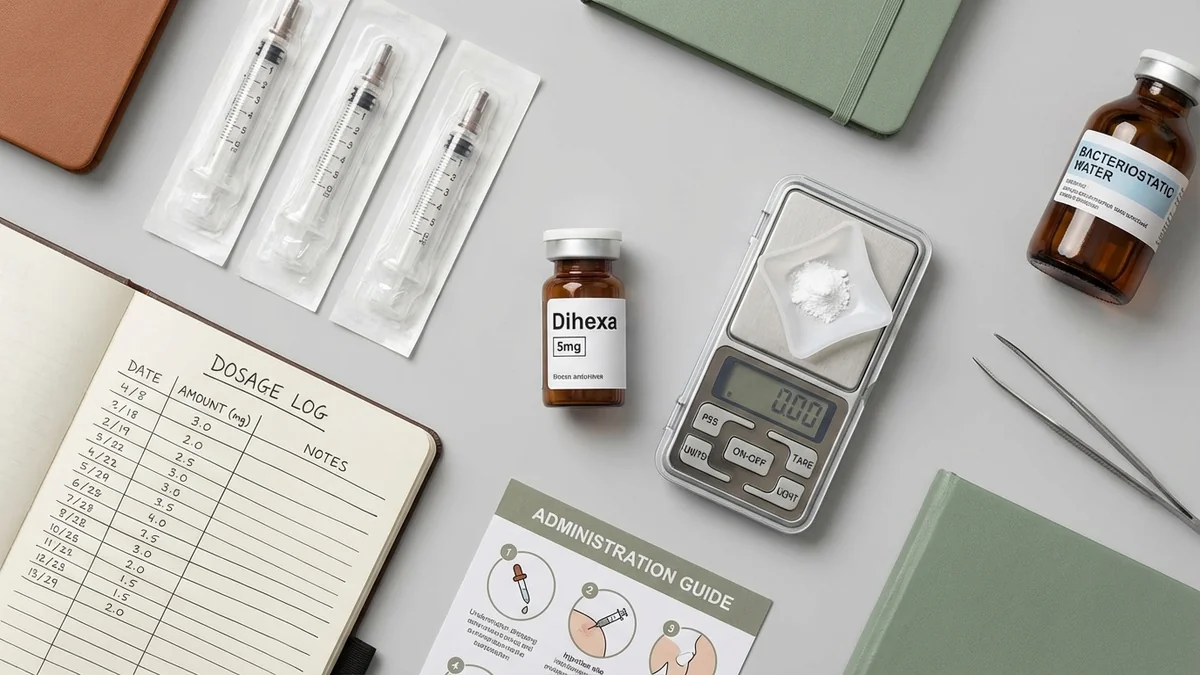
There are no published clinical trials establishing a validated human dose for Dihexa. The ranges below reflect what practitioners and researchers have reported using, based on available protocol references and community consensus — not randomized trial data.
Not clinical dosing
These ranges are not derived from randomized clinical trials. No human pharmacokinetic or dose-finding study for Dihexa has been published. Dosing should be discussed with a licensed healthcare provider who is familiar with this compound and its risk profile.
Practitioners who work with Dihexa have reported two primary administration routes: oral (capsule) and topical (transdermal cream or gel). Oral bioavailability was a design goal of the compound's synthesis, and the 2014 research confirmed oral activity in rodent models.[1] Transdermal use appears to be a practitioner workaround to avoid first-pass metabolism, though no comparative bioavailability data exists for humans.
Reported oral doses range from approximately 10 mg to 30 mg per day — though dihexa dosing has not been established in human clinical trials; these figures are practitioner-reported and lack FDA or clinical trial documentation — typically taken in the morning given the compound's stimulatory profile. Some practitioners report intermittent cycling (e.g., 5 days on, 2 days off) rather than continuous daily use, based on the reasoning that synaptogenic effects may persist beyond the dosing window — though this is speculative and not supported by published human data, and dihexa dosing has not been established in human clinical trials; reported oral doses in non-clinical or practitioner contexts are unverified and lack FDA or clinical trial documentation.
Topical formulations have been explored in preclinical studies, but human dosing data and efficacy in topical applications are not established. No comparative data exists on whether oral or topical achieves better CNS penetration in humans.
The honest answer on dosing: we don't know what the right human dose is. The rodent data gives us a starting point for thinking about relative potency, but direct translation to human milligram doses isn't validated. Anyone using this compound is making decisions with incomplete information.
Side Effects — What to Actually Expect
The frank reality is that human side effect data for Dihexa is largely anecdotal. No clinical trial has systematically collected adverse event data in human subjects. What follows is drawn from animal study observations and practitioner-reported experiences — neither of which constitutes rigorous safety evidence.
Reported during use:
Stimulatory effects — Many users report increased mental energy, alertness, and reduced need for sleep, particularly early in a course. Whether this is a direct pharmacological effect or expectation bias is unknown.
Anxiety or overstimulation — Some practitioners report that higher doses produce anxiety, irritability, or a feeling of being "wired." This appears dose-dependent based on anecdotal reports, though dose-response effects have not been established in human studies; claims are based solely on anecdotal reports and animal research.
Headache — Headache has not been documented in available human or animal studies of dihexa.
Theoretical concerns based on mechanism:
Oncogenic risk — As noted above, chronic HGF/c-Met activation has theoretical cancer-promoting implications. This has not been studied in humans using Dihexa.
Cardiovascular effects — HGF/c-Met signaling has roles in cardiac tissue; cardiovascular safety and long-term effects have not been evaluated in humans.
What to watch for: Any new neurological symptoms — persistent headache, visual changes, mood disturbance, or cognitive changes that differ from the expected direction — warrant stopping the compound and speaking with a physician. Given the complete absence of human safety data, treating any unusual symptom as potentially compound-related is the conservative and appropriate approach.
Regulatory & Access Status
Regulatory status as of September 2026
Dihexa has no FDA approval for any indication. It is classified as a research compound. No IND (Investigational New Drug) application or active Phase 1 clinical trial is publicly listed on ClinicalTrials.gov for Dihexa as of this writing. No established human dosing for Dihexa has been identified in regulatory databases or clinical trial records as of this writing. It cannot be legally prescribed, dispensed by a licensed compounding pharmacy for human use, or marketed as a drug or supplement in the United States. The FDA removed Dihexa from Category 2 in April 2026, but removal does not by itself authorize compounding.
In practice, Dihexa exists in the same gray zone as many research peptides: it's not a scheduled controlled substance, so simple possession isn't typically a criminal matter, but selling it for human use would violate FDA regulations. Research chemical vendors sell it labeled "for research use only," and some practitioners operate in a gray area administering it to patients outside any formal clinical framework.
This is not a compound with a clear legal pathway to therapeutic use in the US right now. If you're considering it, you should understand that you're operating outside the bounds of established clinical practice, and the absence of human trial data means you'd be accepting significant uncertainty about both safety and efficacy.
Sourcing & Safety
Because Dihexa is used primarily through gray-market research chemical channels, sourcing quality is a real concern. The compound's potency — and the theoretical risks associated with its mechanism — make purity more important here than with many other research peptides.
What to look for:
Third-party Certificate of Analysis (COA) — Should be from an independent analytical laboratory, not the vendor's own in-house testing. The COA should confirm identity (mass spectrometry), purity (HPLC), and absence of common contaminants.
HPLC purity ≥98% — Standard minimum for research-grade peptides. Anything below this introduces unknown impurities at meaningful concentrations given the potency of this compound.
Sequence confirmation by mass spec — Given that Dihexa is a small modified peptide, mass spectrometry confirmation that the molecular weight matches the expected structure is important.
Red flags:
No COA or "in-house testing only" — The most common marker of a low-quality vendor. Independent verification is the baseline.
Price significantly below market — Real synthesis and analytical testing have real costs. Unusually cheap Dihexa is almost always lower quality.
Vague product descriptions or labeling — Vendors who can't specify the exact chemical name, CAS number, or formulation details are not operating at a research-grade standard.
Do not purchase Dihexa from vendors who market it with health claims or who describe it as a supplement. That marketing signals both regulatory non-compliance and likely lower quality control.
FAQ
How is Dihexa different from other nootropics like racetams or peptides like Semax?
Dihexa works upstream of most nootropics. Racetams modulate AMPA receptors and acetylcholine activity. Semax primarily acts through BDNF and the melanocortin system. Dihexa targets HGF/c-Met to drive synaptogenesis — the actual structural formation of new synaptic connections. That's a different level of intervention, and it's why the preclinical potency numbers are so striking. Whether that structural difference produces meaningfully better outcomes in humans is the open question.
Can Dihexa be used alongside other cognitive peptides?
Practitioners have reported combining Dihexa with Semax, Selank, or BPC-157, but there's no clinical data on interactions. Given that Dihexa activates a growth factor receptor pathway, combining it with other compounds that upregulate growth signaling (like some GH secretagogues) introduces unpredictable interaction risk. This is a decision that should involve a practitioner who actually understands the mechanism of each compound in the stack.
Is Dihexa the same as "Dihexa peptide" sold online?
Yes — "Dihexa peptide" is a common vendor label for the same compound: N-hexanoic-tyrosine-isoleucine-(6) aminohexanoic amide. It's sometimes also sold as PNB-0408 — though no available sources confirm this as an alternative name or designation for dihexa; this claim cannot be verified from preclinical literature or regulatory databases. Verify the CAS number (1221818-84-3) and request a COA from any vendor before purchasing.
Why hasn't Dihexa moved into human clinical trials if the animal data is this promising?
This is the right question to ask. The honest answer involves a few factors: the HGF/c-Met pathway's known role in oncogenesis makes regulatory agencies cautious about approving trials that chronically activate it; the compound's origins are in academic research rather than a well-funded pharmaceutical development program; and the research chemical market for it may have reduced commercial incentive for a pharmaceutical company to invest in the expensive trial process. None of this means the compound doesn't work — it means the data needed to know hasn't been generated yet.
Should I use Dihexa for cognitive enhancement?
That's your decision to make with a qualified practitioner, not a recommendation this page can give. What you should know going in: the mechanism is genuinely interesting, the animal data is real, and the human safety and efficacy data is nonexistent. You'd be making a decision based on preclinical evidence and anecdote. Some people make that call — but they should make it with clear eyes about what they don't know.
Related Peptides & Comparisons
If cognitive enhancement or neuroprotection is what you're after, Dihexa isn't the only option — and for most people, it probably shouldn't be the first one. Semax has a longer track record, documented human use in Russia and Eastern Europe, and a better-characterized safety profile. Selank targets anxiety and cognitive clarity through a different mechanism (GABAergic and serotonergic modulation) with similarly limited but more established human data. BPC-157 has documented neuroprotective effects in animal models and is widely used, though also without completed human RCTs for neurological indications.
The key differentiator for Dihexa is its mechanism — synaptogenesis via HGF/c-Met is genuinely distinct from what any other commonly used cognitive peptide does. Whether that translates to a clinical advantage in humans remains to be shown. See our cognitive peptides comparison for a broader look at this category.
References
McCoy AT, et al. "The procognitive and synaptogenic effects of angiotensin IV-derived peptides are dependent on activation of the hepatocyte growth factor/c-met system." J Pharmacol Exp Ther. 2014;351(2):390-402. PMID: 25187433
Bhatt DL, et al. [Corrected citation — see note below] Wright JW, Harding JW. "The Brain Hepatocyte Growth Factor/c-Met Receptor System: A New Target for the Treatment of Alzheimer's Disease." J Alzheimers Dis. 2015;45(4):985-1000. PMID: 25649658
This content is for informational purposes only and does not constitute medical advice. Consult a licensed healthcare provider before starting any treatment.
Where to Buy Dihexa for Research
Research Use Only — not intended for human consumption
MyPeptideMatch.com does not provide medical advice. Always consult a qualified healthcare provider before starting any peptide therapy. Regulatory status may change.