What Is Ovagen?
Ovagen is a three-amino-acid peptide: glutamic acid, aspartic acid and leucine, written Glu-Asp-Leu or EDL.[1] It belongs to the "peptide bioregulator" family developed by Vladimir Khavinson at the St. Petersburg Institute of Bioregulation and Gerontology. In some of the group's papers it is coded T-35.[4]
The developers' 2022 review lists Ovagen as a kidney protector and a liver protector.[1] The kidney label is backed by a handful of rat and cell-culture studies. The liver label is backed, in that review, by a 2006 patent filing, not by a published study. Vendors, meanwhile, sell Ovagen mostly for the liver or the gut.
All of the research comes from Khavinson's group and its collaborators, it is cell and animal work only, and it has not been independently replicated. If you are reading about Ovagen because a vendor page promised liver detox or gut repair, the honest answer is that no published study has tested either.
- Ovagen is the synthetic tripeptide Glu-Asp-Leu (EDL), from Khavinson's bioregulator program in Russia.
- Its published research is almost entirely on the kidney: rat models of kidney injury, old rats and aging kidney cell cultures.
- We found no published study of Ovagen for the liver or the digestive tract, the two uses vendors most often claim.
- No human trial appears in PubMed or on ClinicalTrials.gov (searched October 2026), and there is no established human dose.
- "Ovagen" is also the name of an unrelated veterinary hormone product and an unrelated homeopathic remedy. Check which one you are reading about.
| Common Name | Ovagen |
| Sequence | Glu-Asp-Leu (EDL); coded T-35 in some studies |
| Formula / Molecular Weight | C15H25N3O8 / about 375 Da |
| Class | Synthetic short peptide ("peptide bioregulator") |
| Developed by | Khavinson group, St. Petersburg Institute of Bioregulation and Gerontology |
| Primary Research Areas | Kidney injury in rats, aging kidney cell cultures |
| Human Trials | None found in PubMed or ClinicalTrials.gov |
| FDA Status | Not approved for any indication |
| Forms Sold | Lyophilized "research use only" vials, commonly 20 mg |
| Typical Dose | No established human dose |
Three Different Products Called "Ovagen"
This matters because search results mix them up.
- The peptide (EDL). The Khavinson bioregulator this page is about.
- A veterinary hormone. In the animal reproduction literature, Ovagen is a sheep (ovine) follicle-stimulating hormone (FSH) preparation from a New Zealand company, used to make goats and sheep release extra eggs for embryo transfer.[9][10] Most PubMed results for "Ovagen" are about this product, not the peptide.
- A homeopathic remedy. R18 Ovagen is a sublingual homeopathic drop listed on DailyMed, made by Apex Energetics, with ingredients such as agnus castus, progesterone and platinum. Its label lists temporary relief of minor menstrual discomfort, hot flashes and melancholy, and states that the claims are "based on traditional homeopathic practice, not accepted medical evidence. Not FDA evaluated."
None of the three has anything to do with the others. Claims about hormones or menstrual symptoms do not apply to the peptide.
How Does Ovagen Work?
The developers propose that very short peptides cross cell and nuclear membranes and bind DNA or histone proteins, switching tissue-specific genes on or off.[2] For EDL, the support for that idea is mostly computer modeling. Docking studies placed EDL in the minor groove of DNA[3] and predicted that it binds the same short DNA sequence as Bronchogen (Ala-Glu-Asp-Leu), which contains EDL as its last three amino acids.[8]
What was measured in cells:
- Aging kidney cells. In young and aged kidney cell cultures, EDL increased cell proliferation, lowered the aging markers p16, p21 and p53, and raised SIRT6, a protein linked to DNA repair. The related peptide AED did the same.[3]
- Tissue remodeling. In a second kidney culture study, the main target of EDL was MMP-14, an enzyme that remodels the tissue matrix. AED and a calf-kidney extract, not EDL, were the ones that activated cell renewal.[4]
What the Clinical Evidence Actually Shows
There is no clinical evidence, because no human trial of Ovagen has been published in an indexed journal or registered on ClinicalTrials.gov. The animal evidence is a series of rat studies from a Ukrainian university group working with Khavinson's institute.
Drug-induced kidney failure. In rats with kidney failure caused by the chemotherapy drug cisplatin, EDL and two other preparations normalized urine output, creatinine excretion and filtration rate, and reduced protein in the urine. The authors described EDL's effect as the most potent of the peptides tested.[5]
Antibiotic and ischemic injury. In rats with kidney damage from the antibiotic gentamicin, or from cutting off and restoring blood flow, EDL prevented the drop in urine output and the build-up of waste products in the blood. It also reduced protein and sodium loss in the urine and kept antioxidant enzymes from falling.[6]
Old rats. In old rats without kidney injury, EDL increased urine output 1.2- to 1.4-fold and sodium excretion 1.6-fold. Tissue examination showed no signs of kidney toxicity.[7]
These are short reports, mostly in Bulletin of Experimental Biology and Medicine and the Russian-language Advances in Gerontology. The abstracts do not give group sizes or doses, and none of the results has been reproduced by an unrelated lab.
Liver and gut. We found no published study of EDL on liver cells, liver injury or the digestive tract. The developers cite a 2006 patent for the liver claim.[1] A patent describes what an inventor claims; it is not peer-reviewed evidence. Vendor claims about tight junctions, gut barrier repair, inflammatory bowel disease or detoxification have no PubMed study behind them that we could find.
What the Evidence Does Not Show
- Any effect in people. No study has measured kidney function, liver enzymes, digestive symptoms or anything else in humans taking Ovagen.
- A liver or gut effect at all. The published work is on the kidney.
- That injected Ovagen reaches its target. No study tracks where the peptide goes or how long it lasts after injection.
- A working dose. There is no dose-finding study in animals or people.
- Safety. No human safety data exists.
- Independent confirmation. Every EDL study we found lists Khavinson as an author.
Typical Dosing — What the Research Has Used
No established human dose
No published trial has established a safe or effective human dose of Ovagen. Everything below describes what circulates online, not dosing guidance.
The rat studies are the only place EDL was given to a living animal, and their abstracts do not report the doses or routes used.[5][6][7] The cell studies tested it on isolated kidney cells. Nothing in the published research converts to a human dose.
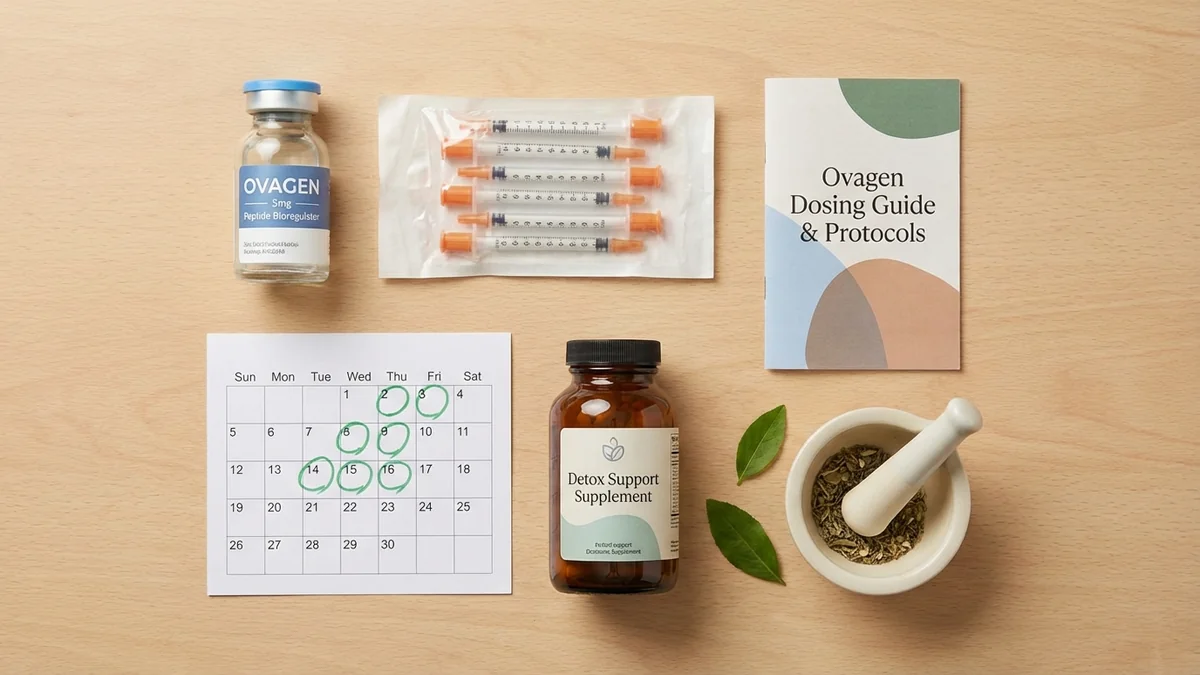
Online, Ovagen is sold as 20 mg vials of powder to be mixed with bacteriostatic water and injected under the skin. A community schedule of 200 µg once daily for 10 days, repeated every four to six months, is commonly discussed. It is identical to the schedule circulated for Livagen, which suggests it was carried over between products rather than worked out for Ovagen.
Our Ovagen dosing protocol page covers that schedule and the reconstitution math for a 20 mg vial. It is useful for measuring accurately. It is not evidence that the dose works.
Side Effects — What to Actually Expect
There is no human safety data on Ovagen, so there is no evidence-based side effect profile. The one relevant finding is that old rats given EDL showed no signs of kidney toxicity on tissue examination.[7] That is a single animal result, not a human safety record.
What can reasonably be said:
- Injection-related risks apply to any injected research peptide: redness, pain or swelling at the site, and infection if the product or technique isn't sterile.
- Product quality is the bigger unknown. "Research use only" vials are not made under drug manufacturing rules. Purity, actual peptide content and sterility depend on the seller.
- Unknown long-term effects. The proposed mechanism involves changing gene expression. There is no data on repeated courses.
The rat studies showed EDL changing urine output and sodium handling.[7] If you have kidney disease, take diuretics or blood pressure medicines, or are pregnant or breastfeeding, talk to a physician before using it.
Regulatory & Access Status
Access status as of October 2026
The Ovagen peptide is not FDA-approved for any indication and cannot be prescribed as an approved drug. One clinic on our directory currently lists Ovagen among the peptides it offers.
In the US, Ovagen is sold by research chemical vendors as vials labeled "not for human consumption." The only "Ovagen" on DailyMed is the homeopathic R18 Ovagen drop described above, which is a different product with different ingredients. Buying a research peptide means accepting that nobody has verified what is in the vial.
Sourcing & Safety
If you decide to buy Ovagen anyway, these checks matter more than the brand name:
- An independent certificate of analysis (COA) from a named third-party lab, dated, for the specific batch you receive.
- HPLC purity of at least 98%, plus mass spectrometry confirming the compound is Glu-Asp-Leu, about 375 Da. Vendor pages for bioregulators often list wrong sequences, so check both on the COA.
- Sterility and endotoxin testing for anything you plan to inject.
Treat as red flags: no third-party COA, claims that Ovagen "detoxes" the liver or heals the gut, hormone or menstrual claims (those belong to the unrelated products), and references to human studies that can't be found in PubMed.
What Makes Ovagen Different
Ovagen is one of the shortest bioregulators, at three amino acids, and it is the one where the marketing and the research point at different organs. Vendors sell it for the liver and the gut; the published studies are about the kidney.
It is also unusually close in structure to its siblings. Add an alanine to the front and you get Bronchogen (Ala-Glu-Asp-Leu), which the developers assign to the lungs. Ovagen and Cartalax (Ala-Glu-Asp) were tested side by side in kidney cells and kidney injury models, with overlapping results.[3][5][7] That overlap is hard to square with the idea that each peptide acts on one organ.
Ovagen vs. Related Khavinson Bioregulators
| Parameter | Ovagen | Livagen | Bronchogen |
|---|---|---|---|
| Sequence | Glu-Asp-Leu (EDL) | Lys-Glu-Asp-Ala (KEDA) | Ala-Glu-Asp-Leu (AEDL) |
| Length | 3 amino acids | 4 amino acids | 4 amino acids |
| Developer label | Kidney and liver | Liver | Lungs |
| What vendors claim | Liver, gut | Liver, immune | Lungs |
| Main published evidence | Rat kidney injury studies, kidney cell cultures | Liver cell cultures, chromatin in donated blood cells | Bronchial cell cultures |
| Published human trials | None | None | None |
| FDA status | Not approved | Not approved | Not approved |
FAQ
What is Ovagen peptide?
Ovagen is a synthetic three-amino-acid peptide, glutamic acid-aspartic acid-leucine (Glu-Asp-Leu, or EDL), from Vladimir Khavinson's 'peptide bioregulator' program in St. Petersburg. It is sold as a research peptide and is not an approved drug in the US. The same name is also used for an unrelated veterinary hormone product and an unrelated homeopathic remedy.
What is Ovagen peptide used for?
Vendors market it for the liver, the digestive tract and general anti-aging. The developers' own review lists it as a kidney and liver protector. The published studies of EDL are almost all on the kidney: rat models of drug-induced and ischemic kidney injury, old rats, and aging kidney cell cultures. No human study has been published.
What are the benefits of Ovagen peptide?
In rats, EDL reduced protein loss in urine, prevented the drop in urine output and the rise in blood waste products after kidney injury, and supported antioxidant enzymes in kidney tissue. In aging kidney cell cultures it lowered aging markers. Whether any of that happens in people is unknown, and we found no published study of Ovagen for liver or gut health.
What is the dosage of Ovagen peptide?
No human dose has been established by any published trial, and the rat study abstracts do not report the doses used. A community schedule of 200 µg injected daily for 10 days is commonly discussed online. It does not come from a study.
Is Ovagen given by injection?
Research vials of Ovagen are sold as a powder to be mixed with bacteriostatic water and injected under the skin, and that is how community protocols use it. No study has tested injected Ovagen in humans, so there is no data on how well it is absorbed or how long it lasts.
Is Ovagen FDA approved?
No. The Ovagen peptide has no FDA approval for any use. The only 'Ovagen' on DailyMed is R18 Ovagen, a homeopathic drop with different ingredients, whose label states its claims are not FDA evaluated.
Related Peptides & Comparisons
If you are looking at Ovagen for liver support, Livagen is the Khavinson peptide with the most direct liver-cell research, though it is also thin. For gut-focused peptides that have more research behind them, see BPC-157 and KPV. From the same bioregulator family, Epithalon, Pinealon and Vilon are the most searched. For the broader picture, see our guide to anti-aging and longevity treatments.
References
- Khavinson V, Linkova N, Kozhevnikova E, et al. "Transport of Biologically Active Ultrashort Peptides Using POT and LAT Carriers." Int J Mol Sci. 2022;23(14):7733. PMID: 35887081
- Khavinson VK, Popovich IG, Linkova NS, et al. "Peptide Regulation of Gene Expression: A Systematic Review." Molecules. 2021;26(22):7053. PMID: 34834147
- Khavinson VKh, Tarnovskaia SI, Lin'kova NS, et al. "Tripeptides slow down aging process in renal cell culture." Adv Gerontol. 2014;27(4):651-656. PMID: 25946838
- Khavinson VKh, Lin'kova NS, Polyakova VO, et al. "Peptides regulate expression of signaling molecules in kidney cell cultures during in vitro aging." Bull Exp Biol Med. 2014;157(2):261-264. PMID: 24958378
- Zamorskii II, Shchudrova TS, Lin'kova NS, et al. "Peptides Restore Functional State of the Kidneys During Cisplatin-Induced Acute Renal Failure." Bull Exp Biol Med. 2015;159(6):736-739. PMID: 26515176
- Zamorskii II, Shchudrova TS, Lin'kova NS, et al. "Nephroprotective Effect of EDL Peptide at Acute Injury of Kidneys of Different Genesis." Bull Exp Biol Med. 2017;163(3):389-393. PMID: 28744634
- Zamorskii II, Shchudrova TS, Zeleniuk VG, et al. "The influence of peptides on the morphofunctional state of old rats kidneys." Adv Gerontol. 2018;31(4):498-504. PMID: 30607912
- Khavinson VK, Lin'kova NS, Tarnovskaya SI. "Short Peptides Regulate Gene Expression." Bull Exp Biol Med. 2016;162(2):288-292. PMID: 27909961
- McNatty KP, Hudson NL, Ball K, et al. "Superovulation and embryo recovery in goats treated with Ovagen and Folltropin." N Z Vet J. 1989;37(1):27-29. PMID: 16031503
- Gonzalez-Bulnes A, Santiago-Moreno J, Cocero MJ, et al. "Effects of FSH commercial preparation and follicular status on follicular growth and superovulatory response in Spanish Merino ewes." Theriogenology. 2000;54(7):1055-1064. PMID: 11131324
This content is for informational purposes only and does not constitute medical advice. Consult a licensed healthcare provider before starting any treatment.