What Is Livagen?
Livagen is a four-amino-acid peptide: lysine, glutamic acid, aspartic acid and alanine, written Lys-Glu-Asp-Ala or KEDA.[1] It comes out of the "peptide bioregulator" program led by Vladimir Khavinson at the St. Petersburg Institute of Bioregulation and Gerontology. According to the developers, the sequence was designed from the amino acid makeup of liver polypeptide extracts,[3] and their own review lists it as a "hepatoprotector."[1]
What exists behind that label is a set of cell and tissue-culture studies, one rat feeding study, a series of lab experiments on white blood cells from elderly donors, and no published human trials. Most of the work dates from 2001 to 2007. It comes from Khavinson's group or from labs that publish with it, and it has not been independently replicated.
If you found Livagen on a vendor page promising liver detox or regeneration, the short version is this: the lab findings are small and mostly 20 years old, and nobody has shown that injecting Livagen does anything for a human liver.
- Livagen is the synthetic tetrapeptide Lys-Glu-Asp-Ala (KEDA), developed by Khavinson's group in Russia as a liver "bioregulator."
- Its evidence base is cell-culture, tissue-culture and rat research, plus lab studies on chromatin in white blood cells taken from people aged 75 to 91.
- No human trial of Livagen appears in PubMed or on ClinicalTrials.gov (searched October 2026).
- It is not FDA-approved for any use and does not appear in Drugs@FDA or DailyMed.
- There is no established human dose. Community-reported amounts span roughly 200-fold, from about 100 µg to 20 mg a day.
| Common Name | Livagen |
| Sequence | Lys-Glu-Asp-Ala (KEDA) |
| Formula / Molecular Weight | C18H31N5O9 / about 462 Da |
| Class | Synthetic short peptide ("peptide bioregulator") |
| Developed by | Khavinson group, St. Petersburg Institute of Bioregulation and Gerontology |
| Primary Research Areas | Liver cell cultures, chromatin in aging white blood cells, digestive enzymes in rats |
| Human Trials | None found in PubMed or ClinicalTrials.gov |
| FDA Status | Not approved for any indication |
| Forms Sold | Lyophilized "research use only" vials |
| Typical Dose | No established human dose |
How Does Livagen Work?
The proposed mechanism is the same one Khavinson's group applies to all its short peptides. Peptides of two to seven amino acids are said to be small enough to cross cell and nuclear membranes and bind DNA or histone proteins directly, changing which genes are read.[2] In this model each peptide is tissue-specific, and Livagen's tissue is the liver.
Here is what was actually measured with Livagen:
- Liver cells and liver tissue. In cultured rat hepatocytes from animals aged 1 to 24 months, Livagen increased protein synthesis, with the biggest effect in cells from old rats. Epithalon, tested alongside it, did not change protein synthesis in the same cells.[3] In organ cultures of rat liver, Livagen was reported to stabilize tissue structure and support cell regeneration.[4]
- Tissue specificity. In rat explant cultures, Livagen stimulated growth of liver tissue, while three sibling peptides stimulated brain cortex, brain subcortex and thymus tissue respectively.[5][6]
- Chromatin in aging white blood cells. With age, chromatin packs more tightly and genes in those regions go quiet. In lymphocytes from people aged 75 to 88, Livagen loosened this condensed chromatin and activated ribosomal genes.[9][10] A Tbilisi genetics group that has co-published with Khavinson reported similar results in later lab work.[11][12][13]
- An enzyme effect. In human serum in a test tube, Livagen inhibited enzymes that break down enkephalins (natural opioid peptides), with an IC50 of 20 µM. It did not bind brain opioid receptors.[14]
'Lymphocytes from old people' is not a human trial
Several Livagen papers have titles that mention elderly people. In each, blood cells were drawn from elderly donors and Livagen was added to those cells in a culture dish. Nobody in those studies took Livagen.
The DNA-binding mechanism itself is mostly inferred. For Livagen specifically, we found no study that measured the peptide binding DNA inside a liver cell.
What the Clinical Evidence Actually Shows
There is no clinical evidence in the usual sense, because no human trial of Livagen has been published in an indexed journal or registered on ClinicalTrials.gov. What exists falls into three groups.
Cell and tissue-culture studies. These are the bulk of the evidence and are described above: hepatocyte protein synthesis,[3] liver organ culture,[4] explant growth[5][6] and chromatin changes in donated white blood cells.[9][10][11][12][13] Most are short reports from 2001 to 2007, several in Russian-language journals, and the abstracts give few numbers.
Animal studies. In a rat study, Livagen given by mouth for two weeks lowered digestive enzyme activity in young rats and raised it in old rats, moving the old animals closer to young controls. The same paper reported that small-intestine enzymes barely break Livagen down, which matters if it is to survive being swallowed.[7] A 2020 review by Khavinson and colleagues reports that Livagen and a calf-liver extract (Ventvil) normalized immune and antioxidant status and restored liver function in animal models of hepatitis and cirrhosis, with the strongest effects in aging.[8] That review is in Russian and summarizes the group's own work; we could not find the underlying hepatitis or cirrhosis experiments for Livagen indexed in PubMed.
Human studies. None. You may see vendor listings describing Livagen for heart protection after ischemia, fatty liver disease, statin-related liver injury or alcohol-related liver disease. We found no PubMed study of Livagen for any of those uses. If a seller cites one, ask for the journal reference.
What the Evidence Does Not Show
- Liver benefit in people. No study has measured liver enzymes, liver fat, fibrosis or any other outcome in humans taking Livagen.
- Immune benefit in people. The "immune support" claim rests on chromatin changes in white blood cells in a dish, plus animal results summarized in a review.[8][9] No study has measured immune function in people taking it.
- That injected Livagen reaches the liver. No published work tracks where the peptide goes after injection, or how long it lasts.
- A working dose. There is no animal-to-human dose conversion and no human dose-finding trial.
- Safety. No human safety data exists, short- or long-term.
- Independent confirmation. We found no lab outside Khavinson's network that has tested Livagen.
Typical Dosing — What the Research Has Used
No established human dose
No published trial has established a safe or effective human dose of Livagen. Everything below describes what the research used and what circulates online, not dosing guidance.
The research doses do not convert to a human dose. The rat study gave Livagen by mouth for two weeks,[7] and the enzyme work used micromolar concentrations in serum.[14] The other studies tested it on isolated cells or tissue.
Community-reported amounts for the injectable vials vary widely: from about 100–200 µg a day in short courses, to 2–5 mg a day, to 10–20 mg a day, usually for 10 to 30 days and repeated two or three times a year. That is roughly a 200-fold spread, and it means nobody has done the work to find out which amount, if any, does something in a person.
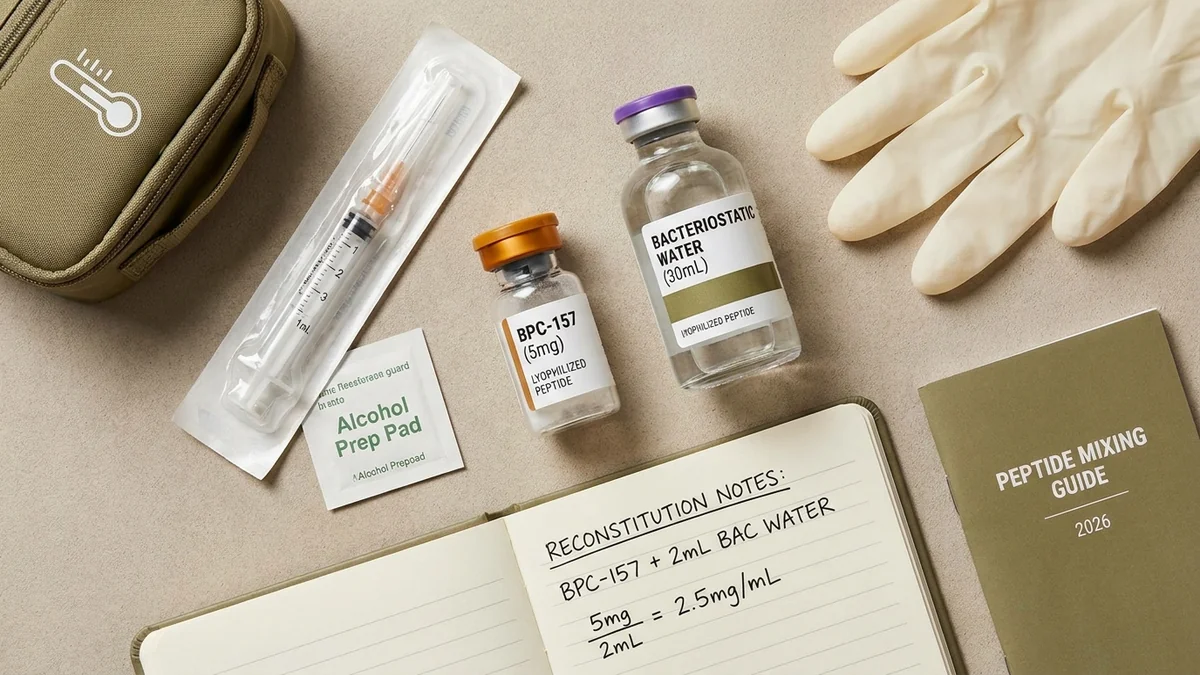
Our Livagen dosing protocol page covers the commonly discussed community schedule of 200 µg daily for 10 days, with the reconstitution math for a 20 mg vial. It is useful for measuring accurately. It is not evidence that the dose works.
Side Effects — What to Actually Expect
There is no human safety data on Livagen, so there is no evidence-based side effect profile. Vendor and community sources describe side effects as "minimal," but that reflects the absence of studies, not a finding.
What can reasonably be said:
- Injection-related risks apply to any injected research peptide: redness, pain or swelling at the site, and infection if the product or technique isn't sterile.
- Product quality is the bigger unknown. "Research use only" vials are not made under drug manufacturing rules. Purity, actual peptide content and sterility depend entirely on the seller.
- Unknown long-term effects. The proposed mechanism involves changing gene expression and chromatin structure. There is no data on what repeated courses do over years.
If you have liver disease, take medicines processed by the liver, have an autoimmune condition, or are pregnant or breastfeeding, the absence of any safety data is a strong reason to talk to a physician first. A peptide with no human data is not a substitute for diagnosis and treatment of a liver problem.
Regulatory & Access Status
Access status as of October 2026
Livagen is not FDA-approved for any indication and has no entry in Drugs@FDA or DailyMed. It is not an approved drug, so it cannot be prescribed as one. One clinic on our directory currently lists Livagen among the peptides it offers.
In the US, Livagen is sold by research chemical vendors as lyophilized vials labeled "not for human consumption." Selling a research peptide for human use is a regulatory problem for the seller, and buying one means accepting that nobody has verified what is in the vial.
Sourcing & Safety
If you decide to buy Livagen anyway, these checks matter more than the brand name:
- An independent certificate of analysis (COA) from a named third-party lab, dated, for the specific batch you receive.
- HPLC purity of at least 98%, plus mass spectrometry confirming the compound is Lys-Glu-Asp-Ala, about 462 Da. Bioregulator sequences are often mixed up online, so check the sequence and molecular weight on the COA.
- Sterility and endotoxin testing for anything you plan to inject.
Treat as red flags: no third-party COA, claims that Livagen "detoxes" or regenerates the liver, claims about heart protection or fatty liver disease, and references to human studies that can't be found in PubMed.
What Makes Livagen Different
Livagen shares its first three amino acids, Lys-Glu-Asp, with Pancragen (Lys-Glu-Asp-Trp) and Testagen (Lys-Glu-Asp-Gly); only the last one differs.[1] The developers assign each of the three to a different organ, which is a strong claim for a one-amino-acid change, and it has not been tested head to head.
Livagen was also often tested alongside Epithalon (Ala-Glu-Asp-Gly), and in liver cells the two behaved differently: Livagen raised protein synthesis and Epithalon did not.[3] In serum, Livagen inhibited enkephalin-degrading enzymes at a much lower concentration than Epithalon (IC50 20 µM against 500 µM).[14]
Livagen vs. Related Khavinson Bioregulators
| Parameter | Livagen | Pancragen | Ovagen |
|---|---|---|---|
| Sequence | Lys-Glu-Asp-Ala (KEDA) | Lys-Glu-Asp-Trp (KEDW) | Glu-Asp-Leu (EDL) |
| Length | 4 amino acids | 4 amino acids | 3 amino acids |
| Developer label | Liver | Pancreas | Kidney and liver |
| Main evidence | Cell and tissue cultures, one rat study | Cell cultures, rat and monkey studies | Rat kidney studies, kidney cell cultures |
| Published human studies | None | Small studies in elderly people, from the developers network | None |
| FDA status | Not approved | Not approved | Not approved |
FAQ
What is Livagen peptide?
Livagen is a synthetic four-amino-acid peptide, lysine-glutamic acid-aspartic acid-alanine (Lys-Glu-Asp-Ala, or KEDA). It was developed by Vladimir Khavinson's group at the St. Petersburg Institute of Bioregulation and Gerontology as a 'peptide bioregulator' for the liver. It is sold as a research peptide and is not an approved drug in the US.
What is Livagen used for?
It is marketed for liver health, immune support and anti-aging. The research behind those claims is cell and tissue-culture work on rat liver cells, a rat feeding study on digestive enzymes, and lab studies on white blood cells taken from elderly people. No human trial of Livagen has been published in PubMed or registered on ClinicalTrials.gov.
What are the benefits of Livagen?
In lab studies, Livagen increased protein synthesis in cultured rat liver cells, most strongly in cells from old animals, and loosened tightly packed chromatin in white blood cells from people aged 75 to 91. A 2020 review by the developers reports liver-protective effects in animal hepatitis and cirrhosis models. None of these effects has been shown in people taking Livagen.
What is the dosage of Livagen peptide?
No human dose has been established by any published trial. Community-reported amounts for injectable vials range from about 100 µg to 20 mg a day in courses of 10 to 30 days, a spread of roughly 200-fold. A schedule of 200 µg daily for 10 days is commonly discussed. None of these figures comes from a study.
Is Livagen FDA approved?
No. Livagen has no FDA approval for any use and does not appear in the FDA's Drugs@FDA database or on DailyMed. Vials are sold labeled for research use only, which means they are not made or tested to drug standards for human use.
Is Livagen the same as Lys-Glu-Asp-Ala or KEDA?
Yes. Lys-Glu-Asp-Ala is the three-letter sequence, KEDA is the one-letter code, and the developers' papers use both names for the same tetrapeptide.
Related Peptides & Comparisons
If you are looking at Livagen for liver support, the closest relative is Ovagen, another Khavinson peptide that vendors also sell for the liver, though its published work is mostly on the kidney. From the same family, Epithalon has the deepest research, and Pinealon, Vilon, Cartalax and Pancragen are the most searched. For immune-focused peptides with more data behind them, see Thymosin Alpha-1 and our guides to immune support and anti-aging and longevity treatments.
References
- Khavinson V, Linkova N, Kozhevnikova E, et al. "Transport of Biologically Active Ultrashort Peptides Using POT and LAT Carriers." Int J Mol Sci. 2022;23(14):7733. PMID: 35887081
- Khavinson VK, Popovich IG, Linkova NS, et al. "Peptide Regulation of Gene Expression: A Systematic Review." Molecules. 2021;26(22):7053. PMID: 34834147
- Brodskiĭ VIa, Khavinson VKh, Zolotarev IuA, et al. "Rhythm of protein synthesis in cultures of hepatocytes from rats of different ages. Norm and effect of the peptide livagen." Izv Akad Nauk Ser Biol. 2001;(5):517-21. PMID: 15926314
- Riadnova IIu, Filippov SV, Iuzhakov VV. "Functional morphology of an organotypic liver culture exposed to the peptide livagen." Adv Gerontol. 2002;10:88-94. PMID: 12577697
- Khavinson VK. "Tissue-specific effects of peptides." Bull Exp Biol Med. 2001;132(2):807-8. PMID: 11713572
- Khavinson VKh, Malinin VV, Chalisova NI, et al. "Tissue-specific action of peptides in tissue culture of rats of various ages." Adv Gerontol. 2002;9:95-100. PMID: 12096446
- Timofeeva NM, Khavinson VKh, Malinin VV, et al. "Effect of peptide Livagen on activity of digestive enzymes in gastrointestinal tract and non-digestive organs in rats of different ages." Adv Gerontol. 2005;16:92-6. PMID: 16075683
- Kuznik BI, Khasanova NB, Ryzhak GA, et al. "The influence of polypeptide liver complex and tetrapeptide KEDA on organism physiological function in norm and age-related pathology." Adv Gerontol. 2020;33(1):159-164. PMID: 32362099
- Khavinson VKh, Lezhava TA, Monaselidze JG, et al. "Effects of Livagen peptide on chromatin activation in lymphocytes from old people." Bull Exp Biol Med. 2002;134(4):389-92. PMID: 12533768
- Khavinson VKh, Lezhava TA, Malinin VV. "Effects of short peptides on lymphocyte chromatin in senile subjects." Bull Exp Biol Med. 2004;137(1):78-81. PMID: 15085253
- Lezhava T, Monaselidze J, Kadotani T, et al. "Anti-aging peptide bioregulators induce reactivation of chromatin." Georgian Med News. 2006;(133):111-5. PMID: 16705247
- Lezhava T, Jokhadze T. "Activation of pericentromeric and telomeric heterochromatin in cultured lymphocytes from old individuals." Ann N Y Acad Sci. 2007;1100:387-99. PMID: 17460203
- Lezhava T, Jokhadze T, Monaselidze J, et al. "Epigenetic modification under the influence of peptide bioregulators on the 'old' chromatin." Georgian Med News. 2023;(335):79-83. PMID: 37042594
- Kost NV, Sokolov OIu, Gabaeva MV, et al. "Effect of new peptide bioregulators livagen and epitalon on enkephalin-degrading enzymes in human serum." Izv Akad Nauk Ser Biol. 2003;(4):427-9. PMID: 12942748
This content is for informational purposes only and does not constitute medical advice. Consult a licensed healthcare provider before starting any treatment.