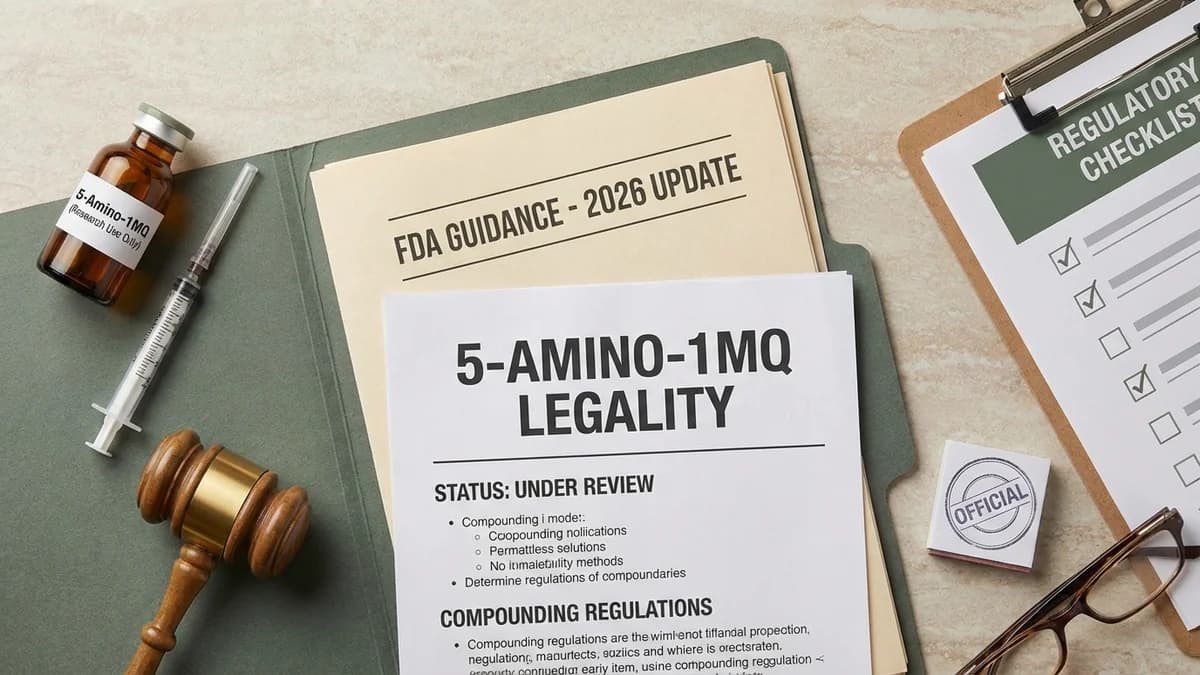
Is 5-Amino-1MQ Legal? FDA Status and Regulations Explained (2026)
If you're researching 5-Amino-1MQ legality, you're probably trying to answer a pretty specific question: can your doctor prescribe it, can a pharmacy make it, and is the product you found online going to get you — or your provider — into trouble? The short answer is that 5-Amino-1MQ occupies a genuinely grey zone in US law, and the details matter enormously depending on how you're trying to access it.
Here's what you need to know upfront: 5-Amino-1MQ is not FDA-approved for any clinical indication as of March 2026.[1] It's classified as a research-only compound, which means its legal use in the United States is formally limited to laboratory and preclinical research settings. That doesn't mean it's a controlled substance — it isn't scheduled under the Controlled Substances Act — but it does mean that selling it as a treatment, prescribing it as a drug, or marketing it for human use sits outside the bounds of current US law. The grey market for this compound is real, active, and not without legal risk.
Key Takeaways
- 5-Amino-1MQ is not FDA-approved for any human indication and carries a "research use only" designation as of March 2026.
- It is not a DEA-scheduled controlled substance, so possession alone doesn't trigger criminal liability the way a Schedule I drug would — but selling or marketing it for human use does violate federal law.
- Compounding pharmacies cannot legally produce 5-Amino-1MQ for patient use because it has not been placed on the FDA's 503A or 503B bulk drug substance lists.
- Prescribing 5-Amino-1MQ is not "off-label prescribing" in the conventional sense — it's prescribing an unapproved drug, which carries distinct legal and liability implications for providers.
- Products sold online as "research use only" are not a legal workaround for human use — the FDA evaluates intended use, not labeling, when determining whether a product is being marketed as a drug.
- The FDA has taken enforcement action against companies marketing unapproved research compounds for human use; consult FDA.gov for current enforcement activity.
Regulatory Status at a Glance
| Category | Status | Detail |
|---|---|---|
| FDA Approval | Not approved | No approved indication for any human use as of March 2026 |
| FDA Compounding (503A) | Not listed | Absent from the 503A bulk drug substance list; compounding for patients not permitted |
| FDA Compounding (503B) | Not listed | Absent from the 503B outsourcing facility list |
| DEA Scheduling | Not scheduled | Not listed under the Controlled Substances Act |
| Prescription Availability | Not available by Rx | No legal prescription pathway exists in the US at this time |
| Research Use | Permitted | Available for legitimate laboratory and preclinical research |
| International (EU/EMA) | Not approved | No EMA marketing authorization |
| International (UK MHRA) | Not approved | No MHRA marketing authorization |
| International (Australia TGA) | Not approved | Not listed on the Australian Register of Therapeutic Goods |
| International (Canada) | Not approved | Not authorized by Health Canada |
Current FDA Status
5-Amino-1MQ has no FDA approval for any clinical indication.[1] The compound — formally a small-molecule selective inhibitor of nicotinamide N-methyltransferase (NNMT) — has not completed the Investigational New Drug (IND) application process, has not entered Phase I human safety trials, and does not have a New Drug Application (NDA) or Biologics License Application (BLA) on file with the FDA.[2]
What it does have is a growing body of preclinical data. Research published in peer-reviewed journals has demonstrated that 5-Amino-1MQ inhibits NNMT with measurable selectivity, increasing NAD⁺ salvage pathway flux in cell culture and rodent models.[3] That's genuinely interesting science. But preclinical data and FDA approval are separated by a decade-long, multi-billion-dollar process that 5-Amino-1MQ has not begun.
The FDA's position is straightforward: a compound intended for human use that hasn't been approved through the NDA or BLA pathway is an unapproved new drug under the Federal Food, Drug, and Cosmetic Act (FD&C Act).[2] Marketing, distributing, or selling such a compound for human therapeutic use is illegal, regardless of how the product is labeled.
The "research only" classification means exactly what it says. The compound can be legally synthesized, sold, and used within a legitimate research context — university laboratories, pharmaceutical R&D settings, and licensed research institutions. It cannot legally be sold to consumers for self-administration, prescribed by physicians as a treatment, or compounded by pharmacies for patient dispensing.
Compounding Status
This is where a lot of people get confused, so let's be precise.
Under Section 503A of the FD&C Act, licensed pharmacists can compound drugs for individual patients based on a valid prescription — but only using bulk drug substances that appear on an FDA-approved list, or that are components of FDA-approved drugs, or that appear in the United States Pharmacopeia (USP) or National Formulary (NF).[2]
5-Amino-1MQ appears on none of these lists. The FDA's 503A bulk drug substance list (sometimes called the "Category 1" list for nominated substances under evaluation) does not include 5-Amino-1MQ as of March 2026. It has not been nominated through the formal FDA docket process for inclusion, and it has not received a Category 1 (permissible pending review) or Category 2 (not permissible) designation — it simply hasn't entered that pipeline at all.[1]
The 503B outsourcing facility pathway, which governs larger-scale compounding operations, has the same limitation. Without an FDA listing, a 503B facility has no legal basis to produce 5-Amino-1MQ for patient use.
What this means practically: if a compounding pharmacy offers you 5-Amino-1MQ, they're operating outside the bounds of federal compounding law. That's not a minor technicality — it's a meaningful legal and safety concern. Compounding oversight exists specifically to ensure that products dispensed to patients meet quality, sterility, and potency standards. Products sourced outside that framework carry no such assurances.
For comparison, BPC-157 and TB-500 are other research compounds navigating similar compounding gray areas — you can read more about their specific regulatory status in their respective profiles on MyPeptideMatch.
Enforcement Actions
The FDA has taken enforcement action against companies marketing unapproved research compounds — including NNMT-related and metabolic research chemicals — for human use. Consult FDA.gov and the FDA's MedWatch program for current enforcement activity related to 5-Amino-1MQ specifically.[1]
What the FDA's enforcement pattern looks like in this category, generally:
The agency typically targets sellers and distributors rather than individual buyers. Warning letters are the most common first step, followed by injunctions, product seizures, and, in egregious cases, criminal referrals to the Department of Justice. The FTC has also taken action against companies making unsubstantiated health claims about unapproved compounds sold online.
The clearest enforcement risk sits with:
- Vendors selling 5-Amino-1MQ as a "supplement" or "metabolic support" product for human use
- Clinics prescribing or dispensing it without a legal compounding pathway
- Online retailers shipping it internationally while marketing it for therapeutic purposes
Individual patients who purchase research compounds for personal use occupy a lower enforcement priority, but that doesn't mean zero risk — and it certainly doesn't mean the products they're receiving are safe, accurately dosed, or what the label says they are.
Prescription vs. Over-the-Counter vs. Research Use
Let's map out the three pathways people actually try to use — and what's legal about each.
Prescription: There is currently no legal prescription pathway for 5-Amino-1MQ in the United States. A physician cannot write a valid prescription for a compound that isn't FDA-approved and isn't on the 503A/503B compounding lists. A prescription written for 5-Amino-1MQ has no legal mechanism for fulfillment at a licensed US pharmacy.
Over-the-counter: 5-Amino-1MQ is not approved as a dietary supplement under the Dietary Supplement Health and Education Act (DSHEA) of 1994.[4] It doesn't meet the definition of a dietary ingredient, and marketing it as a supplement while making structure/function or disease claims would draw FDA scrutiny. Some vendors sell it in capsule form online — that doesn't make it legal; it makes it an unapproved drug sold without authorization.
Research use: This is the only legally clear pathway. Purchasing 5-Amino-1MQ as a research chemical — for use in a laboratory, by a qualified researcher, for non-human research purposes — is legal. The compound is available from research chemical suppliers who sell it with "not for human use" labeling. The legal protection here is real, but it's narrow: the moment the intended use shifts to human administration, the "research use only" label becomes legally irrelevant.
The "research use only" label is not a loophole. The FDA evaluates intended use based on the totality of circumstances — how a product is marketed, who's buying it, how it's dosed, and what the seller knows about how customers are using it. A vendor selling 5-Amino-1MQ in 50mg capsules through a website with testimonials about fat loss and metabolic benefits isn't protected by a "research use only" disclaimer.[2]
Gray market products and international purchasing carry compounding risks of their own. Products ordered from overseas suppliers — particularly those based in China or Eastern Europe — are not subject to FDA manufacturing standards. Customs enforcement for personal-use quantities of non-scheduled research chemicals is inconsistent, but importation of unapproved drugs for human use violates federal law regardless of the quantity.
What "Off-Label" Actually Means
This distinction matters, and it's one that even some clinicians get wrong.
"Off-label prescribing" refers to a physician using an FDA-approved drug for an indication, population, or dosage that isn't in the approved labeling. It's legal, common (roughly 20% of all prescriptions in the US are off-label),[5] and covered by established medical-legal doctrine. A physician prescribing metformin for weight management in non-diabetic patients, for example, is practicing off-label prescribing.
That framework does not apply to 5-Amino-1MQ. Because 5-Amino-1MQ has never received FDA approval for any indication, prescribing it isn't off-label use — it's prescribing an unapproved new drug. These are legally distinct categories with different implications.
For providers, the liability calculus is meaningfully different. Off-label prescribing of an approved drug is supported by a body of safety data from the approval process. Prescribing an unapproved compound with only preclinical data means your patient has no FDA-validated safety profile, no established dosing range from human trials, and no pharmacovigilance system tracking adverse events. If a patient is harmed, the malpractice exposure is significant — and professional licensing boards in most states take a dim view of prescribing unapproved compounds outside of a formal research protocol.
Clinics offering 5-Amino-1MQ as a clinical service should be a red flag, not a selling point. You can find guidance on identifying legitimate peptide therapy providers in our clinic finder and our guide to evaluating peptide therapy clinics.
State-Level Variations
Federal law sets the floor here, but state medical and pharmacy boards add their own layer of oversight.
State pharmacy boards have the authority to discipline pharmacists and pharmacies that compound substances outside the 503A framework. Several state boards — including those in California, Texas, and Florida — have issued guidance explicitly prohibiting compounding of substances not on the FDA's approved bulk drug substance lists. A pharmacy compounding 5-Amino-1MQ in those states faces both federal and state regulatory exposure.
State medical boards can sanction physicians for prescribing unapproved compounds without adequate scientific basis or informed consent documentation. The standard of care analysis varies by state, but prescribing a compound with no human safety data and no FDA approval pathway is difficult to defend before most state boards.
Telemedicine prescribing adds another variable. The Ryan Haight Act and its post-COVID modifications govern controlled substance prescribing via telemedicine, but 5-Amino-1MQ isn't a controlled substance. State telemedicine laws still apply, however, and prescribing an unapproved compound to a patient you've never examined in person raises both legal and ethical concerns that vary by jurisdiction.
If you're working with a telehealth provider who's offering 5-Amino-1MQ, ask them directly: what is the legal basis for this prescription, which pharmacy is filling it, and is that pharmacy on the FDA's 503A or 503B registered list? If they can't answer those questions clearly, that's your answer.
International Status
The picture outside the US is consistent: 5-Amino-1MQ has no marketing authorization in any major regulatory jurisdiction as of March 2026.
European Union (EMA): No marketing authorization from the European Medicines Agency. Research use is permitted under applicable national research regulations, but clinical or commercial distribution for human use is not authorized.[1]
United Kingdom (MHRA): No UK marketing authorization. Post-Brexit, the MHRA operates independently of the EMA, but the outcome here is the same — no approved indication, no legal clinical use.
Australia (TGA): Not listed on the Australian Register of Therapeutic Goods (ARTG). The TGA's Special Access Scheme (SAS) theoretically allows access to unapproved therapeutic goods in specific clinical circumstances, but 5-Amino-1MQ has not been granted SAS status.
Canada (Health Canada): Not authorized under the Food and Drugs Act. Canada's Special Access Program (SAP) exists for unapproved drugs in serious or life-threatening conditions, but no SAP authorization for 5-Amino-1MQ has been reported.
Purchasing 5-Amino-1MQ from international online vendors and importing it into the US doesn't circumvent FDA jurisdiction. The FDA has authority over drugs imported for personal use, and while enforcement of small personal-use shipments is inconsistent, the legal risk is real and the quality risk is arguably greater.