P21, also written P021 or "Peptide 021," is a small synthetic peptide designed from the most active piece of ciliary neurotrophic factor (CNTF), a natural protein that helps nerve cells survive and grow. Researchers built it to reach the brain and studied it for memory loss and Alzheimer's disease.
In mice and rats, P21 boosted the growth of new nerve cells and improved memory. It has never been tested in people. It's sold online as a nootropic, mostly as a nasal spray, and labeled for research use only.
- P21 is a tiny peptide based on CNTF: four amino acids plus an added chemical group to help it reach the brain.
- It isn't related to the p21 protein (CDKN1A) that controls cell division.
- In mice and rats, it improved memory, increased new nerve cells and reduced Alzheimer's-like changes. Nearly all of this comes from one lab.
- No human study exists. Safety in people is unknown.
- Online users report 500 mcg to 2 mg a day as a nasal spray. No dose has been tested.
- It isn't FDA approved and is sold as a research chemical.
| What it is | Synthetic CNTF-based peptide: four amino acids (DGGL) plus an adamantylglycine |
| Molecular weight | 578.7 g/mol |
| Common forms | Nasal spray; 5 mg or 10 mg powder vials |
| Human studies | None |
| Animal studies | Mice and rats, mostly from one lab |
| FDA status | Not approved; sold for research use only |
| In sport | Not named; at risk under WADA's unapproved-substance rule (S0) |
What Is P21?
P21 was developed in Khalid Iqbal's lab at the New York State Institute for Basic Research in Developmental Disabilities. The team mapped which short stretch of the CNTF protein does the work, then built a peptide around it. Their 2010 paper described the compound, Ac-DGGLAG-NH2, and named it P21.[1]
To make it last longer and cross the blood-brain barrier, the researchers attached an adamantylated glycine to one end. That change helped protect it from enzymes that break peptides down.[2]
P21 replaced an earlier, longer version called Peptide 6, an 11-amino-acid piece of CNTF that the same lab tested first.[3] Phanes Biotech, a company Iqbal co-founded, is developing P21 as a drug.[10][12]
P21 vs the p21 protein
If you search PubMed for "p21," almost everything you'll find is about a different molecule: the p21 protein, also called CDKN1A or p21/WAF1, which brakes cell division and is widely studied in cancer. The P21 nootropic peptide has nothing to do with it. Check that the product you're buying lists the nootropic's sequence, Ac-DGGLAG-NH2.
How P21 Works
In animal studies, P21 works through two linked effects:[4]
- Blocks LIF signaling. It competes with leukemia inhibitory factor (LIF), a signal that holds back the growth of new nerve cells.
- Raises BDNF. It increases brain-derived neurotrophic factor, a protein that supports learning and memory. Higher BDNF lowers the activity of an enzyme called GSK-3β, which drives the tau tangles seen in Alzheimer's disease.
Full-length CNTF was once tested in people as a drug, but it caused weight loss and other side effects. P21 was designed as a small piece that might keep the brain effects without those problems.[4] That hasn't been tested in humans.
What People Use P21 For
All of these uses come from animal research:
- Memory and learning. In normal adult mice, P21 improved short-term and spatial memory.[1] In old rats, it slowed age-related memory decline.[5]
- Alzheimer's disease. In Alzheimer's model mice given P21 in food for 6 to 12 months, it reduced abnormal tau, lowered soluble amyloid beta at 6 months, and improved memory and nerve cell growth.[6][12]
- Brain fog and focus. This is the main reason people buy it online. No study has tested it for this.
- Brain injury. The earlier Peptide 6 increased new nerve cells by 80% in mice after a brain injury.[7]
The Research Behind P21
| Study | Animals | What they found |
|---|---|---|
| First P21 study[1] | Normal adult mice | Better learning and memory; more new nerve cells |
| Aging study[5] | Rats 22 to 24 months old | Less memory decline; more BDNF and new nerve cells |
| Alzheimer's model, 6 to 12 months[6] | Alzheimer's model mice | Less abnormal tau, less soluble amyloid beta at 6 months, better memory |
| Early treatment[8] | Alzheimer's model mice from 3 months old | Prevented memory loss and nerve damage; fewer deaths |
| Down syndrome model[9] | Down syndrome model mice | Treatment before and after birth prevented memory problems later |
| CDKL5 deficiency[10] | Mice | Worked in cells, but didn't raise BDNF or fix brain defects in living mice |
Most of the evidence comes from one lab. Nearly every P21 paper is from Iqbal's group or its collaborators. A 2024 study led by a University of Bologna group, with Iqbal as a co-author, tested P21 in a rare genetic disorder. It helped nerve cells in a dish but had little effect in living mice.[10]
A retracted paper. A 2011 study comparing earlier CNTF peptides (Peptide 6 and 6A) with Cerebrolysin was retracted in 2026.[11] You may still see it cited online.
No human data. P21 has never been given to people in a published study, and there are no registered clinical trials.[12]
Is P21 Legal?
P21 isn't FDA approved for any use. It isn't a legal dietary supplement, and it isn't on FDA's 503A bulk substance lists or among the substances nominated for them.[13] It's sold online as a research chemical, labeled not for human consumption.
In sports, P21 isn't named on the WADA Prohibited List. WADA's S0 rule bans, at all times, any pharmacological substance not covered elsewhere on the list that has no government approval for human therapeutic use.[14] P21 has no such approval.
If you want care for memory or focus problems, start with a doctor. You can also find a peptide clinic near you.
P21 vs Other Nootropic Peptides
People often compare P21 with Cerebrolysin and Semax:
| P21 | Cerebrolysin | Semax | |
|---|---|---|---|
| What it is | Single synthetic CNTF-based peptide | Mixture of pig-brain peptides | Synthetic peptide based on ACTH |
| Human data | None | Clinical trials, mostly in stroke and dementia | Russian clinical studies |
| Approval | None | Approved in some countries outside the US | Approved in Russia |
| How it's taken | Nasal spray or injection (online use) | Injection or IV infusion | Nasal drops |
No study has compared any of these head to head.
P21 Dosage
No tested human dose
P21 has never been given to people in a study, so there is no proven dose. The numbers below come from sellers and online users. Talk to a licensed clinician before you use it.
Nasal spray (most common): users report 500 mcg to 2 mg a day. Check how much each spray delivers on your product's label.
Injection under the skin: 100 to 500 mcg a day, often 5 days a week, in 4 to 6 week cycles.
What animals got: most mouse studies mixed P21 into food at about 162 nanomoles per mouse per day,[2] and the rat aging study gave 500 nanomoles per kg per day by mouth.[5] These don't convert directly to a human dose.
P21 dosage chart (5 mg vial)
| Dose | Units with 1 mL BAC water | Units with 2 mL BAC water |
|---|---|---|
| 250 mcg | 5 units | 10 units |
| 500 mcg | 10 units | 20 units |
| 1 mg | 20 units | 40 units |
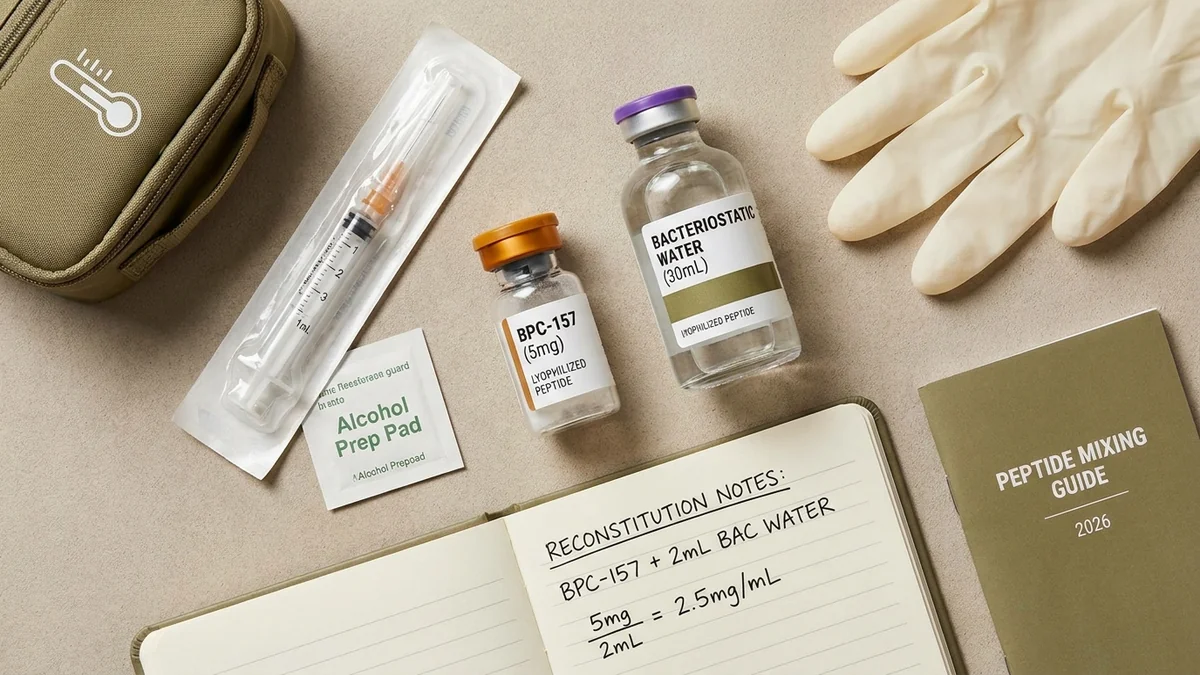
With 1 mL of bacteriostatic (BAC) water, each unit on a U-100 insulin syringe holds 50 mcg. At 500 mcg a day, a 5 mg vial lasts 10 days. Use our peptide calculator for a 10 mg vial or other volumes, and the reconstitution guide for mixing steps.
P21 Side Effects
No one has studied P21's side effects in people.
What animal studies found: a review of the research found no weight loss, tumors or signs of pain in rodents, with the longest study running about 18 months in Alzheimer's model mice.[2][12] The peptide didn't trigger a detectable immune reaction in rats.[15] Unlike full-length CNTF, it didn't cause weight loss.[2][12]
What users report: headaches, feeling unwell and irritability, mostly at higher nasal doses. Some forum users warn that common nasal doses are too high. These reports are unverified.
The bigger unknowns:
- Safety in people, short or long term
- Product quality. Nasal sprays and powders are sold without drug-grade testing. Check that the label lists P21's formula, C27H42N6O8.
- Effects of raising nerve growth signals over months or years
Who should avoid it: anyone pregnant or breastfeeding, anyone under 18, anyone with cancer or a history of it, and athletes who are drug tested.
Frequently Asked Questions
What is P21 peptide? A small synthetic peptide based on CNTF, studied in mice and rats for memory and Alzheimer's disease.
Is P21 peptide the same as the p21 protein? No. The p21 protein controls cell division. The P21 nootropic is unrelated.
Has P21 been tested in humans? No. All studies are in animals or cells.
What is the P21 peptide dose? No dose has been tested. Users report 500 mcg to 2 mg a day as a nasal spray.
How many units is 500 mcg of P21? With a 5 mg vial and 1 mL of BAC water, 500 mcg is 10 units.
Is P21 better as a nasal spray or an injection? No study has compared them. Most users prefer nasal sprays.
What are the side effects of P21? Unknown in people. Animal studies found no tumors or weight loss, and no immune reaction in rats.
How does P21 compare to Cerebrolysin and Semax? Cerebrolysin and Semax have human studies and approvals outside the US. P21 has only animal data.
Is P21 legal? It's sold as a research chemical. It isn't FDA approved and may be banned in sport under WADA's S0 rule.
How long does P21 take to work? No human data exist. Animal studies ran for weeks to months.
References
- Li B, Wanka L, Blanchard J, et al. Neurotrophic peptides incorporating adamantane improve learning and memory, promote neurogenesis and synaptic plasticity in mice. FEBS Lett. 2010;584(15):3359-3365. PMID: 20600002
- Baazaoui N, Iqbal K. Prevention of dendritic and synaptic deficits and cognitive impairment with a neurotrophic compound. Alzheimers Res Ther. 2017;9(1):45. PMID: 28655344
- Blanchard J, Wanka L, Tung YC, et al. Pharmacologic reversal of neurogenic and neuroplastic abnormalities and cognitive impairments without affecting Aβ and tau pathologies in 3xTg-AD mice. Acta Neuropathol. 2010;120(5):605-621. PMID: 20697724
- Kazim SF, Iqbal K. Neurotrophic factor small-molecule mimetics mediated neuroregeneration and synaptic repair: emerging therapeutic modality for Alzheimer's disease. Mol Neurodegener. 2016;11(1):50. PMID: 27400746
- Bolognin S, Buffelli M, Puoliväli J, Iqbal K. Rescue of cognitive-aging by administration of a neurogenic and/or neurotrophic compound. Neurobiol Aging. 2014;35(9):2134-2146. PMID: 24702821
- Kazim SF, Blanchard J, Dai CL, et al. Disease modifying effect of chronic oral treatment with a neurotrophic peptidergic compound in a triple transgenic mouse model of Alzheimer's disease. Neurobiol Dis. 2014;71:110-130. PMID: 25046994
- Chohan MO, Bragina O, Kazim SF, et al. Enhancement of neurogenesis and memory by a neurotrophic peptide in mild to moderate traumatic brain injury. Neurosurgery. 2015;76(2):201-215. PMID: 25255260
- Baazaoui N, Iqbal K. Prevention of amyloid-β and tau pathologies, associated neurodegeneration, and cognitive deficit by early treatment with a neurotrophic compound. J Alzheimers Dis. 2017;58(1):215-230. PMID: 28387677
- Kazim SF, Blanchard J, Bianchi R, Iqbal K. Early neurotrophic pharmacotherapy rescues developmental delay and Alzheimer's-like memory deficits in the Ts65Dn mouse model of Down syndrome. Sci Rep. 2017;7:45561. PMID: 28368015
- Mottolese N, Loi M, Trazzi S, et al. Effects of a ciliary neurotrophic factor (CNTF) small-molecule peptide mimetic in an in vitro and in vivo model of CDKL5 deficiency disorder. J Neurodev Disord. 2024;16(1):65. PMID: 39592934
- Retraction: Regional comparison of the neurogenic effects of CNTF-derived peptides and cerebrolysin in AβPP transgenic mice. J Alzheimers Dis. 2026;111(4):1893. PMID: 42015030
- Alzheimer's Drug Discovery Foundation. Cognitive Vitality report: P021. Updated May 12, 2025. alzdiscovery.org
- U.S. Food and Drug Administration. Bulk drug substances nominated for use in compounding under section 503A. Updated May 14, 2026. fda.gov
- World Anti-Doping Agency. The 2026 Prohibited List, section S0. wada-ama.org
- Khatoon S, Chalbot S, Bolognin S, et al. Elevated tau level in aged rat cerebrospinal fluid reduced by treatment with a neurotrophic compound. J Alzheimers Dis. 2015;47(3):557-564. PMID: 26401692
This information is for educational purposes only and does not constitute medical advice. Always consult a qualified healthcare provider before starting any peptide therapy. Regulatory status may change.